



September liquidity events related to portfolio companies in which PIF invests through its private equity holdings.
Realized distributions turn paper gains into cash that can be redeployed into new investments to drive future returns. Pomona Investment Fund (PIF) is built around this dynamic.
By purchasing private equity (PE) fund interests later in their life cycles, PIF focuses on investments with greater visibility into near-term return of capital. As distributions are received, that capital is recycled into new opportunities.
Below, we highlight select recent exit transactions from PIF, illustrating why liquidity matters in private equity investing. (Learn more about the importance of liquidity.)
Distributions as a percent of total return1
PIF: 58%
Peer average: 29%
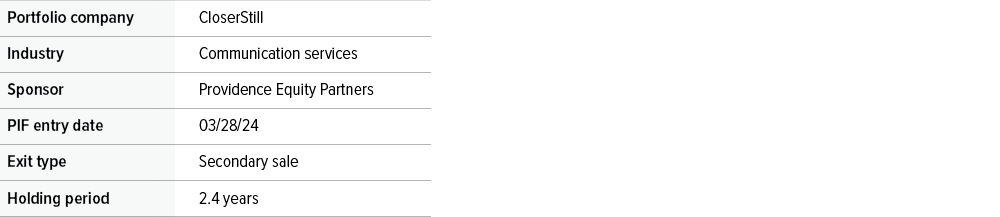
Searchlight Capital Partners invests in CloserStill Media to support next phase of growth 
Searchlight Capital Partners, L.P. and Providence Equity Partners L.L.C. announced that Searchlight agreed to invest in CloserStill Media, a B2B events platform, in partnership with Providence, which has owned the business since 2018.
Searchlight and Providence will have co-control of CloserStill, with Providence having the opportunity to re-invest in the company to support its next phase of growth.
Founded in 2008 and headquartered in London, CloserStill operates a portfolio of top B2B events across four high growth sectors: Technology, Healthcare, Learning & HR, and Future Transport & Infrastructure. Its flagship events include Ai4, the global Tech Show portfolio, the London Vet Show, Data Centre World, PTE World, Learning Technologies, and The Dentistry Show.
Under Providence’s ownership, CloserStill has grown fivefold, successfully expanding from three to four verticals through a combination of organic growth, new event launches, and targeted M&A. Recent acquisitions have extended the platform and broadened its offering to include digitally enabled formats such as one-to-one meetings, executive roundtables and lead-enrichment products. Providence also supported CloserStill through significant investments in talent, capabilities, and technology during its period of ownership, strengthening and enhancing the company’s service offerings.
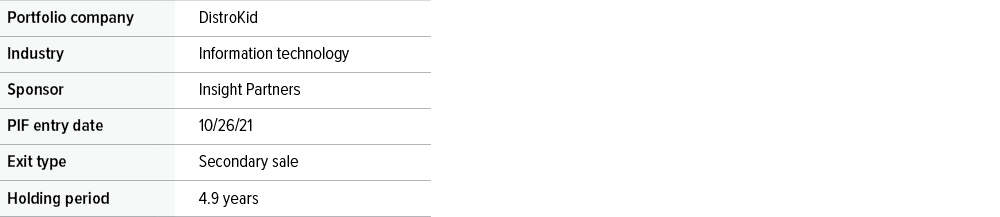
CVC Capital Partners makes majority investment in DistroKid 
DistroKid, a global music distributor, announced that CVC Capital Partners, a global private markets investment firm, signed a definitive agreement to make a majority investment in the company via CVC Capital Partners IX. DistroKid’s longtime investor, Insight Partners, retains a significant minority stake. The transaction closed in the third quarter of this year. Terms were not disclosed.
Founded in 2013, DistroKid has grown beyond music distribution to offer a broad set of tools for independent musicians. Along with music and video distribution, DistroKid offers instant mastering, direct-to-fan experiences, on-demand and custom merchandise, and more. The company continues to invest in new tools that make it easier for musicians around the world to create and release music and connect with listeners.
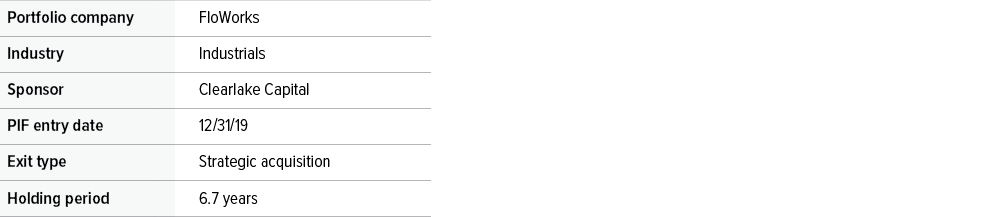
Wynnchurch Capital completes $1.6bn sale of FloWorks to Ferguson Enterprises 
Middle-market private equity firm Wynnchurch Capital sold industrial distribution platform FloWorks International to Ferguson Enterprises in a cash transaction valuing the business at approximately $1.6 billion.
The deal marks the exit of Wynnchurch’s investment after acquiring the Houston-based company in January 2023 and executing an acquisition-led growth strategy that significantly expanded the business.
During its ownership, FloWorks completed seven addon acquisitions, helping transform the company into a specialty distribution platform generating more than $1 billion in annual revenue. The acquisitions broadened the company’s product offering, diversified its industrial end markets, expanded its geographic reach, and strengthened relationships with customers and suppliers.
FloWorks supplies engineered flow control products and technical solutions for maintenance, repair, and operations (MRO) applications across sectors including chemicals, downstream refining, renewable energy, and other industrial markets. Its portfolio includes valves, automation systems, corrosion-resistant flow control products, rotating equipment, filtration systems, and instrumentation.
Following completion of the transaction, FloWorks will become part of Ferguson Enterprises, providing the distributor with an expanded presence in industrial flow control products and technical services.
Clearlake Capital, which retained a minority stake when Wynnchurch acquired FloWorks in 2023, also participated in the investment through the sale process.
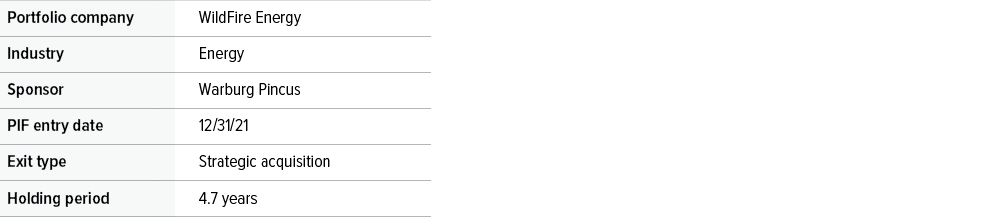
Warburg Pincus and Kayne Anderson sell WildFire Energy to Magnolia Oil & Gas for $4.06 bn 
Kayne Anderson and Warburg Pincus sold WildFire Energy to Magnolia Oil & Gas Corporation for approximately $4.06 billion. The acquisition was unanimously approved by Magnolia’s board of directors.
WildFire is an independent energy company focused on the acquisition, development, and optimization of oil and gas assets in the Austin Chalk, Eagle Ford, and Woodbine formations of South Texas. Warburg Pincus, Kayne Anderson, and the WildFire management team partnered together in 2019 to form the company, and since then, have grown the business into one of the largest privately owned oil and gas producers in the United States.
Over the course of the partnership, WildFire expanded its position through a series of strategic acquisitions, starting with the acquisition of Hawkwood Energy in 2021, as well as a highly effective organic growth strategy. Today, the company produces 53 Mboe/d (~70% oil) across ~810,000 net acres and has built a leading platform characterized by top-tier well performance, inventory depth, capital efficiency, and strong free cash flow generation.
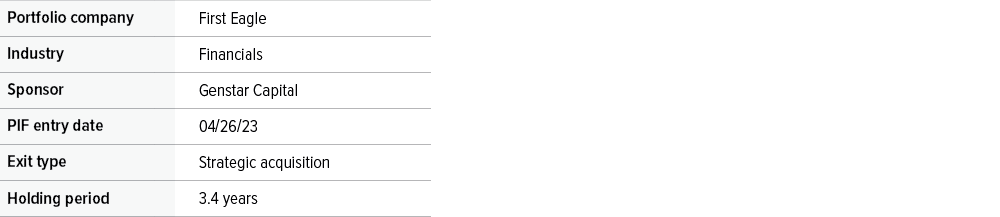
Victory Capital to acquire First Eagle Investments, creating a $571 bn diversified global asset manager 
Victory Capital Holdings, Inc. announced it has entered into a definitive agreement to acquire 100% of First Eagle Investments, an independent, privately held global asset manager with approximately $222 billion in assets under management as of July 31, 2026, from Genstar Capital and First Eagle employees.
Upon closing, the combined company is expected to have approximately $571 billion in total client assets, positioning Victory Capital as one of the largest publicly traded traditional asset managers in the U.S.
First Eagle will operate on Victory Capital’s platform, while retaining its brand, investment autonomy, and, most importantly, its existing investment processes— the same model that has made Victory Capital’s prior transactions successful. First Eagle’s $41 billion CLO and alternative credit platform will serve as the combined company’s alternative investments platform post-closing. Victory Capital and First Eagle will work together to ensure a seamless transition for clients, including continuity in how their money is managed and how they are served.
Types of liquidity events
- Continuation vehicle: A PE firm extends its holding period in a portfolio company through a new fund.
- IPO: A privately held company lists on a public exchange, converting the PE firm’s stake into publicly traded shares.
- Recapitalization: A portfolio company issues debt to pay a dividend to the PE firm, generating returns prior to exit.
- Secondary sale: A PE firm sells its stake in a company to another PE firm.
- Strategic acquisition: Another company acquires the portfolio company, typically at a premium that reflects its strategic value.
Risk of investing Discussed below are the investments generally made by Investment Funds and the principal risks that the Adviser and the Fund believe are associated with those investments and with direct investments in operating companies. These risks will, in turn, have an effect on the Fund. In response to adverse market, economic or political conditions, the Fund may invest in investment grade fixed income securities, money market instruments and affiliated or unaffiliated money market funds or may hold cash or cash equivalents for liquidity or defensive purposes, pending investment in longer-term opportunities. In addition, the Fund may also make these types of investments pending the investment of assets in Investment Funds and Co-Investment Opportunities or to maintain the liquidity necessary to effect repurchases of Shares. When the Fund takes a defensive position or otherwise makes these types of investments, it may not achieve its investment objective. The value of the Fund’s total net assets is expected to fluctuate in response to fluctuations in the value of the Investment Funds, direct investments and other assets in which the Fund invests. An investment in the Fund involves a high degree of risk, including the risk that the Shareholder’s entire investment may be lost. The Fund’s performance depends upon the Adviser’s selection of Investment Funds and direct investments in operating companies, the allocation of offering proceeds thereto, and the performance of the Investment Funds, direct investments, and other assets. The Investment Funds’ investment activities and investments in operating companies involve the risks associated with private equity investments generally. Risks include adverse changes in national or international economic conditions, adverse local market conditions, the financial conditions of portfolio companies, changes in the availability or terms of financing, changes in interest rates, exchange rates, corporate tax rates and other operating expenses, environmental laws and regulations, and other governmental rules and fiscal policies, energy prices, changes in the relative popularity of certain industries or the availability of purchasers to acquire companies, and dependence on cash flow, as well as acts of God, uninsurable losses, war, terrorism, earthquakes, hurricanes or floods and other factors which are beyond the control of the Fund or the Investment Funds. Unexpected volatility or lack of liquidity, such as the general market conditions that prevailed in 2008, could impair the Fund’s performance and result in its suffering losses. The value of the Fund’s total net assets is expected to fluctuate. To the extent that the Fund’s portfolio is concentrated in securities of a single issuer or issuers in a single sector, the investment risk may be increased. The Fund’s or an Investment Fund’s use of leverage is likely to cause the Fund’s average net assets to appreciate or depreciate at a greater rate than if leverage were not used. The Fund is a non-diversified, closed-end management investment company with limited performance history that a Shareholder can use to evaluate the Fund’s investment performance. The Fund may be unable to raise substantial capital, which could result in the Fund being unable to structure its investment portfolio as anticipated, and the returns achieved on these investments may be reduced as a result of allocating all of the Fund’s expenses over a smaller asset base. The initial operating expenses for a new fund, including start-up costs, which may be significant, may be higher than the expenses of an established fund. The Investment Funds may, in some cases, be newly organized with limited operating histories upon which to evaluate their performance. As such, the ability of the Adviser to evaluate past performance or to validate the investment strategies of such Investment Funds will be limited. In addition, the Adviser has not previously managed the assets of a closed-end registered investment company. Closed-End Fund; Liquidity Risks. The Fund is a non-diversified closed-end management investment company designed principally for long-term investors and is not intended to be a trading vehicle. An investor should not invest in the Fund if the investor needs a liquid investment. Closed-end funds differ from open-end management investment companies (commonly known as mutual funds) in that investors in a closed-end fund do not have the right to redeem their shares on a daily basis at a price based on net asset value. |