


Growth Investing Beyond Boom and Bust

Senior Portfolio Manager, Large Cap Growth Equities

Client Portfolio Manager, Large Cap Growth Equities and Systematic Equities

Growth investing is often defined by outcomes. We believe it is better defined by process. Forward-looking insights, fundamental judgment, and disciplined portfolio construction can help investors pursue growth with a more deliberate approach to risk.
Key takeaways
In our view, modern, active growth investing rests on three principles that work together.
1. Growth has to be identified through forward-looking inputs. The question is how a company is investing for future growth, not whether its past growth will simply continue.
2. Those inputs need fundamental judgment and sector expertise to separate real innovation from undisciplined spending and to capture growth in both its forms: market expansion and market share gain.
3. Disciplined portfolio construction ties it together, using proprietary analytics to manage concentration risk, strip out unintended exposures, and let stock selection drive returns. Skip this piece, and even the best growth insights can fail to deliver.
A philosophy built on inputs, not outputs
Trailing earnings and revenue growth are not predictive of future growth, as they describe what already happened and are already priced into a stock; they don’t show where the next phase of growth is forming. Backward-looking measures are an incomplete (and sometimes misleading) guide that can potentially lead to chasing stocks rather than investing in stocks.
At Voya, our large cap growth philosophy starts with forward-looking inputs. We use a proprietary signal we call innovation capital intensity. The signal measures a company’s total investment in future growth: qualified growth, capital expenditures, R&D, and brand investment, net of qualified M&A, scaled by average assets. We examine whether a company is reinvesting in itself and how deliberately, relative to peers.
This signal has historically outperformed traditional growth metrics, which suggests it captures a distinct dimension of growth rather than restating past performance. By evaluating reinvestment behavior and capital allocation, we aim to spot growth potential before it shows up in reported results or gets fully priced in.
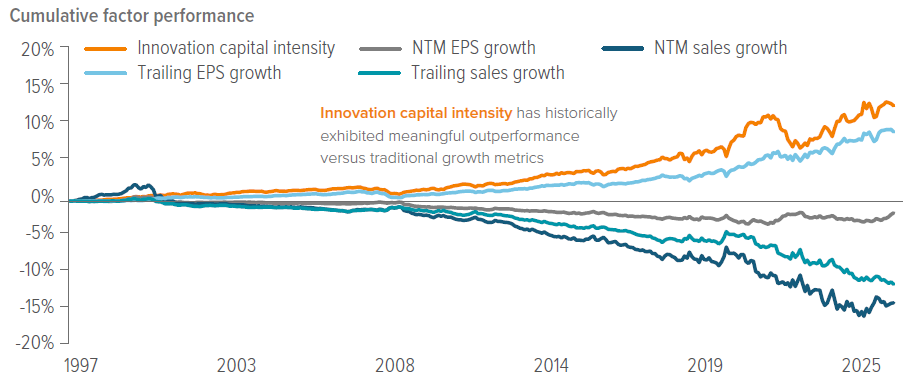
As of 12/31/25. Source: Voya IM. For illustrative purposes only. Performance displayed is not for an investable strategy. Past performance does not guarantee future results. The data above compare traditional growth factors for the constituents of the Russell 1000 Growth Index against proprietary metrics, capital investment, and core profitability.
The focus on innovation capital intensity also broadens the team’s opportunity set, because it applies across the full investment universe and across all sectors, helping identify diversified sources of alpha rather than relying on a narrow set of growth stocks or market themes. Growth itself arrives two ways. Some companies grow the market, creating categories or expanding existing ones through new technology and products. Others grow their share of a market that already exists, through better execution, scale, or capital allocation. Both are reinvestment stories, and both are captured in innovation capital intensity.
Looking across these dimensions helps the team build a portfolio with multiple ways to participate in innovation, reinvestment, and durable compounding.