


CIO Roundtable: A Tightrope of High Expectations

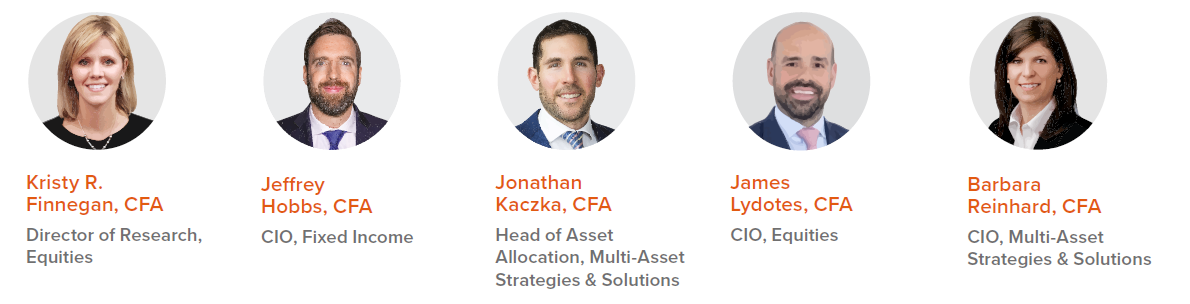
Chief Investment Officer

Director of Research

Chief Investment Officer, Fixed Income

Head of Asset Allocation

Chief Investment Officer, Equities

CIO, Multi-Asset Strategies and Solutions

As the market broadens beyond the AI trade, shifting Fed signals and lofty earnings expectations demand more active judgment.
For much of the past year, investors have had a relatively simple playbook: own U.S. mega cap growth, follow the AI capital spending cycle, and take cues from a highly communicative Federal Reserve. That playbook is becoming less reliable. AI remains a powerful source of growth, but investors are asking tougher questions about compute capacity, AI usage costs, and returns on historic levels of capex. At the same time, market leadership is broadening. That’s a healthier environment, but not necessarily an easier one for investors. If the Fed becomes less transparent about its internal debates and projections, investors will have to do more of the pricing work on their own. That may be the right move in the long run, but it comes with the prospect of greater volatility. You’ve probably seen asset-class “quilt charts” showing that market leadership rarely stays in one place for long. Owning yesterday’s winners can work for a while, but it becomes riskier when the opportunity set begins to rotate. It’s the question at the center of our latest roundtable: Are we at another turning point? Eric Stein, CFA |
Panelist
Peak transparency and a more restrained Fed
Stein: Let’s kick things off with a temperature check on the economy. It’s been surprising how well growth has held up despite the shock from the Iranian conflict. What do you make of that?
Reinhard: You’re right Eric, the U.S. economy has been quite robust in the face of surging energy prices and higher bond yields. Neither are crimping activity. We see a still-solid economic backdrop going into the second half due to lagged effect of rates cuts from the end of 2025 and supportive fiscal policies.
The consumer is still doing well due to an expanding labor market and steady income growth. Additionally, the economic multiplier from capital spending—which seems to be broadening past just AI and technology—should help support the consumer.
Stein: Interest rate markets have swung from pricing two Fed cuts at the start of the Iran conflict to one or two hikes today.1 Where do rates go from here?
Hobbs: We’re in the camp that the Fed holds steady for now until the data give it a clearer reason to move. Inflation is settling into a higher regime—3% is the new 2%—driven by supply disruptions, a more fragmented global backdrop, and AI-related demand. Those forces are offsetting some disinflation from shelter, wages, and technology, which are keeping rates biased somewhat higher.
Stein: We’re also getting first looks at Kevin Warsh. What’s your take on how he’s likely to run the Fed? Hobbs: Warsh is clearly moving away from forward guidance. Markets had grown used to heavy signaling after the 2013 taper tantrum, but this Fed looks more data dependent, with less consensus across Fed governors and less explicit policy guidance. That doesn’t mean no communication. His first press conference still emphasized getting inflation back toward 2%, so the message is more “trust us to stay mindful of inflation” than a detailed rate path.
That same restraint seems to apply to the balance sheet as well. He seems less inclined to expand aggressively in periods of stress. But there’s no easy cure for shrinking it meaningfully. The likely path for inflation is a gradual decline relative to GDP as growth continues.
Reinhard: Warsh wants to remake some parts of how the Fed communicates and conducts policy. This will create some level of uncertainty in financial markets. We would note that equity and bond markets tend to test new chairs, and we don’t think this time will be an exception. The average peak-to-trough decline in the first year of a new Fed chair has generally been more than 10%,2 so a swift market challenge of Chairman Warsh would not be surprising to us.
“Despite a higher inflation regime, hikes look harder to justify.”
Implication: Favor balanced positioning over big rate bets.
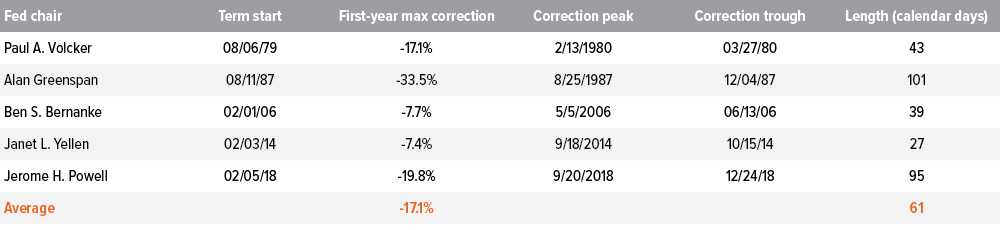
Source: Federal Reserve, Bloomberg.
Stein: There’s an interesting intellectual case for less transparency and less forward guidance. He wants markets to price the economy on their own, rather than constantly guessing the Fed’s reaction function. On a non-farm payroll day or an inflation print, how much of the market move reflects the economic outlook versus the market guessing the Fed’s reaction? If you carry that to the extreme, every move becomes a surprise and volatility rises.
But maybe we’ve hit peak transparency and are coming down the other side. There’s a reason the Fed meets only eight times a year and doesn’t hold a press conference every week. Transparency is useful, but too much can leave markets fixated. My view is that the dot plot should’ve gone away a while ago, and Warsh seems to agree, given that he didn’t submit a dot at the last meeting.
How would less transparency affect equity markets?
Lydotes: I was encouraged by Warsh’s initial commentary on how he’d respond to the data. He may be more measured than I would’ve expected three months ago. That could mean we’re setting up for a Goldilocks scenario of demand-driven inflation and a balanced Fed reaction into year-end.
Finnegan: I agree. The economy has been bifurcated, with parts effectively in recession while the overall market has been supported by AI infrastructure spending. Now cyclical names are seeing signs of life, not because rates are coming down, but because AI diffusion is dragging them along. That means the cyclical trade could hold up even if rates or inflation stay higher. In the unlikely event that rates do fall and inflation tempers, the biggest beneficiaries would be rate-sensitive areas like housing and autos, which remain under significant pressure.
“Cyclical improvement may be driven more by broadening AI benefits than falling rates.”
Implication: Certain cyclicals may work even if inflation and rates stay higher for longer.
AI’s funding frenzy faces scrutiny
Stein: Let’s turn to SpaceX’s IPO, which was enormous by any standard. This market hasn’t been especially friendly to new issuance, and yet we’re suddenly seeing public companies come back in size. Jim, given how the stock has sputtered, was this simply too much supply for the market to absorb?
Lydotes: Supply has been a factor. Only about 5% of SpaceX’s float came out in the IPO, and by year-end that could move closer to 40%, depending on how many existing holders end up selling.3 SpaceX investors aren’t just looking at the company’s story; they’re also seeing the wave of liquidity barreling toward them. But generally speaking, markets can digest equity IPOs this large, so I’d frame it more as a matter of timing than size. Had the IPO come three months earlier, the reception may have been very different.
Finnegan: Right. The IPO came just as investors were getting more cautious about AI compute capacity and the durability of the infrastructure trade. One question is whether frontier models from companies like OpenAI and Anthropic can maintain pricing power as lower-cost Chinese models gain traction.
But lower model costs aren’t necessarily bad for the AI ecosystem. That’s how technology markets evolve: pricing comes down, usage goes up, and adoption broadens. So the risk is less that AI demand disappears, and more that the profit pool shifts. Infrastructure demand can still grow, but the winners and losers across the ecosystem may look different than investors expected.
“Cheap open-source AI models are accelerating usage and driving adoption.”
Implication: Past winners are not guaranteed future success.
Stein: SpaceX issued debt almost immediately after its record-breaking IPO, and hyperscalers have been increasingly active in both public and private credit markets. Jeff, how should we think about that wave of AI-related debt supply?
Hobbs: SpaceX was a useful test case for fixed income markets. When you have a big new name, there’s an itch to be involved. But even with the books oversubscribed, the bonds have underwhelmed at the long end of the curve. We didn’t play out on the curve, which was a good sidestep by the team.
There was a version of the SpaceX bond deal that could have looked compelling: lean into government contracts and put together a lower-risk financing package. That’s not what happened. Instead, $25 billion came to market. Before Verizon’s 2013 purchase of the remaining stake in Verizon Wireless, that would’ve been the biggest debt deal of all time. Now, hyperscalers can bring deals like that on an ordinary Tuesday.
The big challenge for lenders is visibility. Companies are essentially saying, “We’re going to make a ton of money in the future, and we’ll need to borrow a lot more, too, but we can’t tell you our free cash flow or capex spend, though we’ll probably fund it through credit markets.” That’s not exactly a profile we’re eager to lend to for 10-plus years.
The supply is more manageable for the highest-quality hyperscalers because the balance sheets are extraordinary. My favorite stat from April was that the Pentagon said the U.S. had spent $28 billion on the Iran conflict, while Google spent $35 billion in capex in one quarter and Amazon spent $44 billion.4 Even with very strong cash generation, that level of capex has to be debt financed.
The credit quality is strong, with trillions in equity capital sitting beneath the debt. But that doesn’t mean spreads can tighten meaningfully. The carry has improved as spreads have widened, yet every time spreads tighten, more supply follows. In that sense, these bonds can offer carry, but they may struggle to perform.
“Every time hyperscaler spreads widen, supply follows.”
Implication: AI-related bonds may offer attractive yields but spread upside looks capped.
The better AI opportunities we’re seeing are in private markets. There have been transactions tied to cash flows from OpenAI and Anthropic, sometimes with residual value guarantees from unrelated parties. One example we took through our credit committee was an energy deal that vertically integrated from the wellhead all the way to the data center operator. That’s the kind of financing creativity required to support what we’ll probably remember as a historic capex environment.
Broadening beyond U.S. mega cap growth
Stein: Barbara, what are your best ideas for the second half of the year?
Reinhard: We think the opportunity set outside U.S. large caps has become more attractive. Market leadership has broadened beyond U.S. mega cap growth and AI, and non-U.S. markets have performed surprisingly well despite the strong dollar. The S&P 500 is up 10% through July, just trailing the MSCI EAFE, which is up over 11%. EM stocks have done even better, up 20%—or 30% if you take out China.5
Japan is an interesting market to us, supported by corporate reform and buybacks. Europe should benefit from lower energy and gas prices if tensions in the Middle East settle down. And China could make a big comeback after struggling earlier this year if fiscal stimulus comes through.
U.S. large caps still have strong earnings power, but valuations are high, and multiples haven’t expanded much because bond yields haven’t fallen meaningfully. For portfolios that may have become heavily tilted toward U.S. stocks, this is a good time to rebalance.
Kaczka: We’re seeing a similar rotation down in size, toward mid- and small caps. Historically, we’ve leaned into smaller caps after recessions, because their higher operating leverage allows earnings to accelerate as nominal growth recovers. This time, the story is about how smaller companies are adopting new technologies to cut costs and boost productivity, leading to higher profits.
“The rotation down in market cap may have more room if margins continue improving.”
Implication: Consider selective allocations to mid and small caps
Lydotes: I’d also look for value to keep outperforming growth within large caps. The breadth is what stands out. When you look at capex estimates versus three months ago, 9 of the 11 sectors are projecting higher spending, and the other two are holding steady.6 That tells us companies across the economy are more confident in their growth prospects.
Stein: Any specific names?
Lydotes: Can you get excited about unexciting businesses? I’ll give you two: Pepsi and Procter & Gamble. These are big multinational consumer staples companies trading at multi-decade valuation discounts.7 They’ve lapped the GLP and Make America Healthy Again headwinds, and valuations still look attractive. Independent power producers, like Vistra, are also interesting. They benefited from the AI infrastructure narrative around power shortages, then pulled back. More power purchase agreement (PPA) signings could be a positive catalyst for the industry.
Finnegan: Within cyclicals, we like CSX and Singapore Airlines—transports are showing signs of life after years of pressure. Banks are also well positioned, particularly regionals, as lending activity improves. We still like AI infrastructure, too. It was overbought heading into the index rebalance, but if AI usage accelerates as we expect, then semiconductor components—memory, CPUs, and related infrastructure—should benefit.
Stein: Jeff, where does the team see value in fixed income right now?
Hobbs: In public fixed income, we’re focused on earning attractive income without taking unnecessary risk. Intermediate duration bonds look especially interesting if inflation stays sticky but the Fed stops short of raising rates. Two- to five-year bonds can still generate attractive yields without a lot of volatility, and if rates move lower, there could be some upside as well.
On credit risk, it’s more about harvesting carry carefully than expecting another round of spread compression. That favors active, multi-sector fixed income strategies that can rotate across sectors, manage downside risk and stay flexible for periods when volatility creates better entry points.
“Fixed income returns may come more from carry than spread compression.”
Implication: Active multi-sector strategies may harvest income while preserving flexibility.
In private credit, the best opportunities often come when you’re willing to lend where others are pulling back. Most credit sectors are still very tight, but commercial real estate has already gone through a meaningful reset after Covid and higher rates, and lending spreads still look reasonably attractive.
Renewable energy infrastructure is another example. You can provide last-mile capital that bridges sponsor equity to pre-construction financing, with a future PPA takeout. With data centers, the key is structure—being selective about where you sit in the capital stack and how you’re getting compensated. And we like to keep some dry powder. The private credit headlines have eased, but if liquidity pressure comes back, investors with flexible capital may have a chance to step in on better terms.
“The surprise: rates move lower not higher.”
Implication: Intermediate bonds offer attractive carry with incremental upside if rate expectations reverse
Private market questions still simmer
Stein: You anticipated my next question when you mentioned private credit. We still see headlines about redemptions, though they’re less acute than a couple of months ago. What’s your take on the private credit cycle?
Hobbs: The encouraging part is that the pressure on private credit is leading to some better lending structures and a little more discipline. I’d compare the current situation to commercial real estate in 2022: it’ll take time to work through, but it’s not creating the kind of supply-demand mismatch, wider spreads, or tighter credit conditions that would point to a broader macro credit problem.
Stein: What can we glean about private credit from equity markets?
Finnegan: For the publicly traded BDCs and alternative asset managers, the main concern is that growth will be stunted compared to their recent trajectory. Investors are questioning how quickly retail flows, fundraising, and fee growth can recover. Multiples have contracted as a result, even if underlying recovery rates ultimately hold up.
“Private credit redemptions may linger but they’re also improving lending discipline.”
Implication: Treat private credit turbulence as a manager-selection and structure issue.
Stein: I still have some concerns about whether money flowing in from the retail space is being deployed thoughtfully and in the right vehicles. But if we were heading into a broader credit event, bank stocks and public credit spreads would look much worse.
Barbara, private markets are starting to enter the defined contribution conversation. Your team recently published a paper on the potential benefits of adding private assets alongside public stocks and bonds. How do you frame this for retirement savers?
Reinhard: The past 10 years have been exceptional for public markets, with the S&P 500 compounding at more than 15% annually.8 The next 10 could be more favorable for private markets. We think long-term retirement savers should have access to that opportunity. But implementation is important, because private markets aren’t for the faint of heart. Our analysis shows there’s a meaningful potential benefit to having a modest allocation built into an institutionally managed portfolio such as a target date fund.
What could surprise markets?
Stein: Final round: what keeps you up at night, or what’s the biggest surprise you see over the next year?
Kaczka: With AI moving so quickly and diffusing across the economy, my big concern is what could dent AI’s progress. It could be regulation, a technical failure, or a headline that shakes confidence. We’ve already seen glimpses of that risk, from Anthropic briefly pulling one of its models to reports of an advanced OpenAI model breaking out of its testing environment and launching a cyberattack on another AI company. None of that has disrupted momentum, but it does underscore how many unknowns still surround the technology.
I’d also keep an eye on whether certain parts of the AI buildout can sustain elevated margins in historically cyclical industries. Those margins are what have supported valuations. The market surprise would be for rates to move lower, not higher. Inflation expectations remain well behaved, the breadth of CPI pressure is nowhere near 2022 levels, and wages aren’t overheating.
At the same time, our central bank sentiment tracker is almost as hawkish as it was in 2022. With markets leaning toward rate hikes, the surprise could be to the downside.
Hobbs: My surprise call would be that oil prices move meaningfully lower. There’s a lot of incentive to produce oil globally, including potential supply from Venezuela and possibly Iran if peace talks resume, or long-term fractures in the OPEC cartel. Lower oil prices could ease inflation pressures, but if they keep falling, you could see concerns about energy credit. That would be a surprise, given that energy companies have had this supernormal profit boost. If more oil comes into the global market, we’ll be watching for signs that prices could correct more than the market expects.
Reinhard: What keeps me up at night is the bond market, simply because if bond yields climb too high, stocks start to suffer from a lack of oxygen. That affects how we make investment decisions along the continuum between stocks and bonds for clients saving for retirement.
What has the bond market on edge—and what would be a big surprise—is how fast inflation could fall. Several leading indicators suggest inflation could fall pretty dramatically over the next 12 months, which would benefit fixed income.
Finnegan: I think about whether companies will be able to prove returns on all that AI spending. In the past year or two, hyperscaler capex has translated almost immediately into profits for infrastructure companies. But because of depreciation, only a portion of that is recognized as income. For the trade to continue, we need tangible signs, not just anecdotes, that AI users are seeing productivity gains. I think it will be there, but if the returns on investment don’t materialize, it becomes harder to justify the infrastructure buildout, the earnings expectations attached to it, and ultimately the market multiple.
Lydotes: I’ll add one more concern on AI spending: excess compute capacity. We’ve now seen Meta and SpaceX begin leasing out some of their compute. That’s an acknowledgement from two of the biggest AI spenders that they have more capacity than they need right now. If that pattern broadens across hyperscalers and AI investors, it could challenge the AI infrastructure ecosystem. The other surprise for me is the midterm elections. Markets seem to have a stable base case, but election cycles have been anything but predictable. Any shift in expectations heading into the midterms could move markets.
Stein: It’s telling how many of our answers came back to AI. As much as we talk about the broadening market, it’s still a focal point.
I worry about asset prices being so elevated while sentiment is just okay, because a lot rides on confidence holding up. If markets correct 10%, 15%, or 20%, or if private credit turns out to be worse than expected, that could have a big effect because we’re at such frothy levels.
As for a surprise, I’m going with Jon’s answer, that the next Fed move may be a cut, not a hike. Markets are leaning toward hikes, but Warsh wants the cut. If inflation keeps easing, oil prices move lower, and rates across the curve start to fall, the Fed could have room to move lower.
Thank you to our readers for joining us, and we hope you get a chance to step away, recharge, and enjoy the rest of the summer. We’ll be back next quarter to see which of these market surprises have started to take shape.
A note about: risk All investing involves risks of fluctuating prices and the uncertainties of rates of return and yield inherent in investing. All security transactions involve substantial risk of loss. Artificial intelligence (AI) including natural language processing, machine learning, and other forms of AI may pose inherent risks, including but not limited to: issues with data privacy, intellectual property, consumer protection, and anti-discrimination laws; ethics and transparency concerns; information security issues; the potential for unfair bias and discrimination; quality and accuracy of inputs and outputs; technical failures and potential misuse. Reliance on information produced using AI-based technology and tools should factor in these risks.