


Fixed Income Perspectives: Why a Quieter Fed Matters More Than the Next Rate Move

Head of Multi-Sector Fixed Income

Key Takeaways
Hike expectations may be too aggressive. Inflation remains sticky, but not runaway, and we think the stronger case is for the Fed to stay on hold while it waits for clearer evidence.
A less-guided Fed could make markets more volatile. With fewer clues from policy-makers, each payroll report, inflation print, and policy remark may carry more weight.
For fixed income, income remains attractive but selectivity matters. Tight spreads mean returns are more likely to be driven by carry rather that further tightening, while sector allocation, security selection, and flexible portfolio positioning remain the keys to outperformance.
New Fed Chair Kevin Warsh appears ready to give markets fewer signals. That may give the Fed more flexibility, but it also gives every data point more power to move markets.
A whiplash on rate prospects
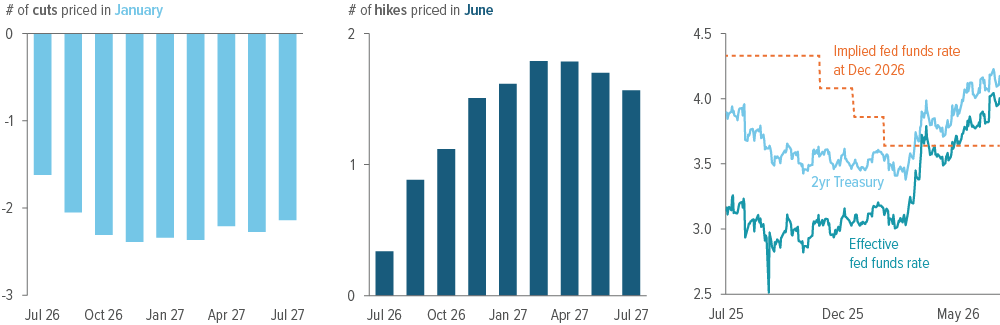
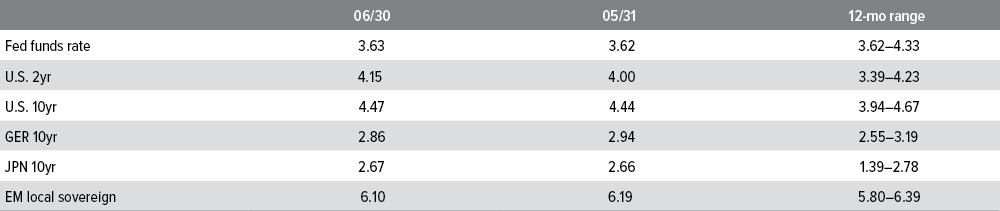
The market has changed its mind fast on where rates are headed. At the start of the year, investors were pricing roughly two Fed cuts in 2026. Now they’re pricing one to two hikes, driving short-term rates sharply higher (Exhibit 1). That swing is a reminder that front-end yields reprice quickly when the macro picture doesn’t follow the script.
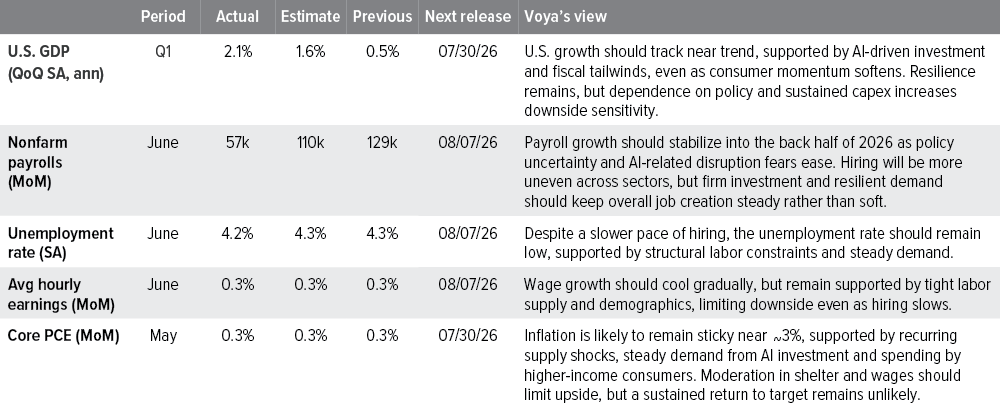
The reversal makes sense—up to a point. Growth was a tailwind in the first half, and the main drivers of demand have held up: consumer spending has surprised to the upside, business investment has benefited from a historic capex cycle, and the government continues to spend. At the same time, inflation hasn’t broken lower enough to make easing look obvious. Supply-side disruptions, steady demand, and heavy AI-related investment have kept alive our “3% is the new 2%” inflation view.
But anticipating hikes goes too far, in our view. Growth looks increasingly uncertain over an intermediate horizon, and some disinflationary forces are still working through the system, including moderating shelter inflation and wage trends that do not point to a wage-price spiral. It’s still hard for us to envision hikes, so we remain in the Fed-on-hold camp.
As of 06/30/26. Source: Bloomberg, Voya IM.
The bigger story is a Fed with fewer signals
More important than the direction of the next rate move is the way policy is being communicated. Warsh is making a clear move away from forward guidance and toward a more data-dependent framework. With a wider range of policy voices, markets may receive fewer signals about where policy is headed.
There’s an appealing case for this approach. Too much guidance can leave markets fixated. We would argue the dot plot should have gone away a while ago; it can force the hand of monetary policy, which is meant to respond to changing data. If markets price their own view of the economy rather than simply trying to front-run the Fed, the Fed may be able to react more appropriately as the economic cycle evolves.
The tradeoff of less guidance is more volatility. When the Fed less bound by forward guidance, key data releases can matter more because investors have to assess not only the economic signal, but also how the Fed may react. A payroll report or inflation print can therefore create a larger market reaction than it might have under a more clearly signaled policy path. In that sense, a quieter Fed gives each data point more power to reshape expectations for rates.
It would be one thing if these communication changes were coming at a time when economic data were sending a simple message. But they’re not.
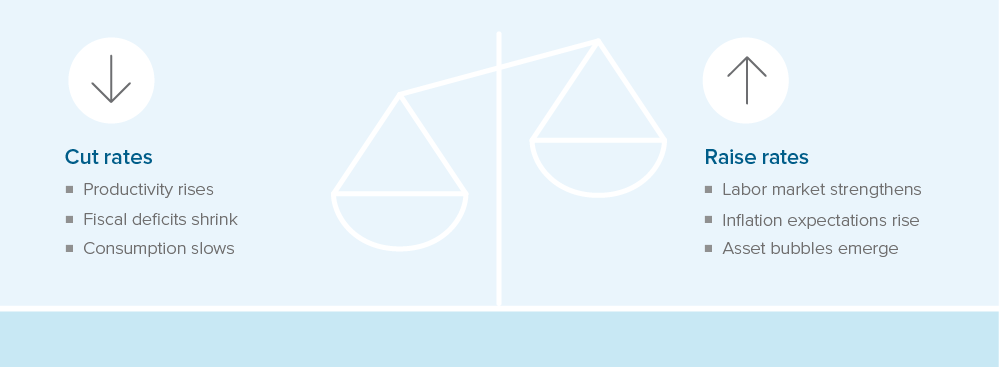
Growth has been resilient, but the drivers look harder to sustain: consumer spending is highly concentrated among wealthy households, the capex cycle cannot compound forever, and fiscal support has limits. Inflation remains sticky, but not runaway. And then there’s the complicated AI question: inflation could remain higher due to near-term investment demand, energy needs, and supply constraints, but longer-term productivity gains could eventually pull inflation lower (Exhibit 3). The Fed still has to decide how much patience that productivity story deserves.
Source: Voya IM.
Implications for fixed income
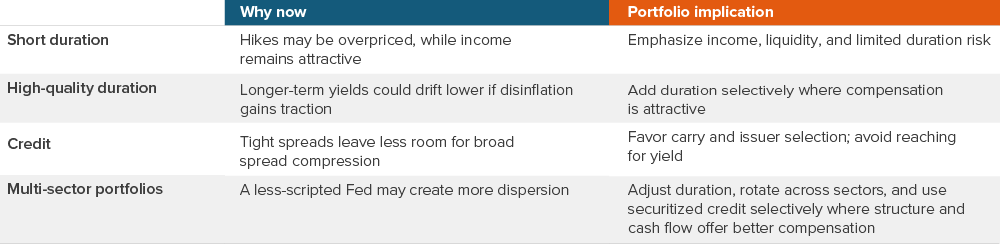
We believe a Fed-on-hold is a constructive setup for fixed income. If sticky inflation keeps rates biased higher but the Fed stops short of hikes, duration remains a clear beneficiary: at the front end, investors can earn attractive income without taking as much curve risk. Farther out the curve, intermediate-duration, high-quality bonds may become more compelling if productivity-driven disinflation begins to show up in the data and longer-term yields drift lower.
Credit requires more discipline. With spreads already tight and volatility low, the easy money from spread tightening is harder to find. That means returns are more likely to be driven by carry, while sector allocation, security selection, and flexible portfolio positioning remain the keys to outperformance. In this environment, investors should focus on balancing yield and downsiside mitigation, while preserving flexibility for the next round of volatility.
The broader beneficiary is active multi-sector fixed income. A less-scripted Fed path should favor managers who can rotate across sectors in pursuit of relative value, and can identify unpriced risk within those sectors. Bonds still offer income, but the next phase may reward investors who do not need the Fed to provide every clue.
Source: Voya IM.
As of 07/20/26. Source: Bloomberg, FactSet, Bureau of Labor Statistics, Voya IM. SA: Seasonally adjusted. PCE: Personal consumption expenditures.
As of 06/30/26. Sources: Bloomberg, JP Morgan, Factset, Voya IM. SA: Seasonally adjusted. PCE: Personal consumption expenditures.
Sector outlooks


- From a valuation perspective, we remain slightly cautious in IG corporates as spreads sit near tight levels and June’s heavy supply exposed how little room there is for further compression.
- Fundamentals remain solid, with earnings expected to stay strong and AI-related capital spending supporting top-line growth, but lower yields have reduced some demand from yield-oriented buyers.
- We still see value in hybrids and BBBs, but would need meaningfully wider spreads before adding broad risk; unexpected issuance, rate volatility, and inflation surprises remain key risks.

- Fundamentals remain supportive, but valuations are not especially compelling. Similar to IG, credit spreads remain near the tighter end of recent ranges and do not currently offer a particularly attractive entry point. While there is no immediate concern about credit fundamentals, the risk/reward tradeoff appears less favorable than earlier in the year.
- August could present better opportunities if spreads widen. Seasonal liquidity conditions and continued issuance could lead to temporary spread widening later in the summer and present an opportunity to selectively add credit exposure.
- Positioning should favor durable business models and higher-quality BB/B risk while remaining selective in CCCs and cyclicals.

- Senior loans remain neutral tactically, with a constructive medium-term setup but softer nearterm technicals as CLO formation slowed and newissue supply stayed elevated.
- Fundamentals remain broadly stable, with leverage inside recent averages and coverage ratios off their troughs, while payment defaults remain below average; however, LME activity and low-single-B downgrade risk still warrant caution.
- Portfolio positioning should retain an up-inquality bias, favoring BB and mid-single-B risk while staying underweight weaker low-single-Bs, CCCs, software, consumer discretionary, autos, chemicals, and media.

- Agency MBS remain neutral tactically, with fundamentals and limited supply still supportive, but spreads realtivly tight.
- Potential GSE buying and subdued organic supply remain positives, while disappointing purchase execution, bank and overseas buyer hesitation, Fed reinvestment into Treasuries, and renewed rate-volatility shocks could derail the view.

- Emerging market hard currency debt has moved to neutral as left tail risk has eased, oil prices have retraced, and external financing conditions have improved.
- Spreads remain tight by historical standards, limiting valuation upside, but elevated absolute yields and continued inflows provide support.
- Positioning should favor higher-quality EM corporates and quasis, with an overweight to Latin America and BBB/BB quality, while remaining cautious on sovereigns, cyclicals, Asia, and GCC exposure.
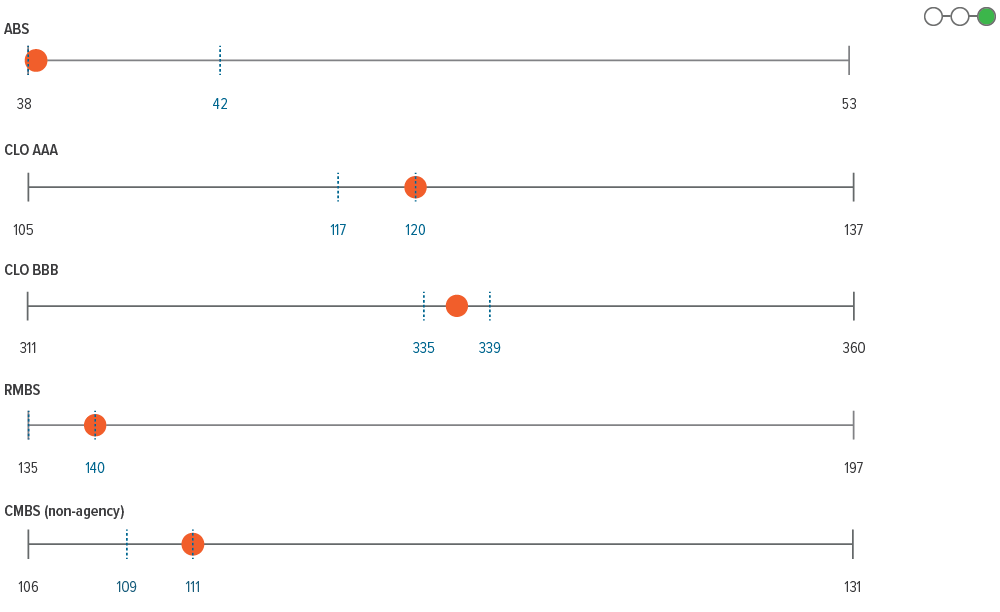
- Securitized credit remains positive overall, but dispersion across sectors has widened.
- Mortgage credit remains a high-conviction positive, supported by strong collateral, accumulated home-price appreciation, robust investor sponsorship, and the prospect of slower supply in the second half.
- Consumer ABS has turned positive as heavy issuance begins to relent and relative value improves, though security selection remains essential given stress among lower- and middleincome consumers.
- CMBS remains modestly positive, while CLOs remain neutral as tight valuations, seasonality, and forward-looking credit concerns offset strong floating-rate demand.
A note about risk: The principal risks are generally those attributable to bond investing. Holdings are subject to market, issuer, credit, prepayment, extension, and other risks, and their values may fluctuate. Market risk is the risk that securities may decline in value due to factors affecting the securities markets or particular industries. Issuer risk is the risk that the value of a security may decline for reasons specific to the issuer, such as changes in its financial condition. The strategy invests in mortgage-related securities, which can be paid off early if the borrowers on the underlying mortgages pay off their mortgages sooner than scheduled. If interest rates are falling, the strategy will be forced to reinvest this money at lower yields. Conversely, if interest rates are rising, the expected principal payments will slow, thereby locking in the coupon rate at below market levels and extending the security’s life and duration while reducing its market value.