


Offer your clients broader large-cap exposure while keeping established market leaders in the portfolio.
Building a diversified large-cap allocation has become harder. The S&P 500 Index is weighted by market capitalization, so the biggest companies have the most influence on returns. As their stock prices rise, their weights also rise, which means broad market exposure can gradually become more dependent on a handful of stocks.
Active strategies may own many of the same market leaders. When those positions sit alongside a cap-weighted index allocation, several strategies can still leave your clients relying on the same few companies. That can help while the largest stocks lead—but when leadership shifts, the allocation may provide less diversification than intended.
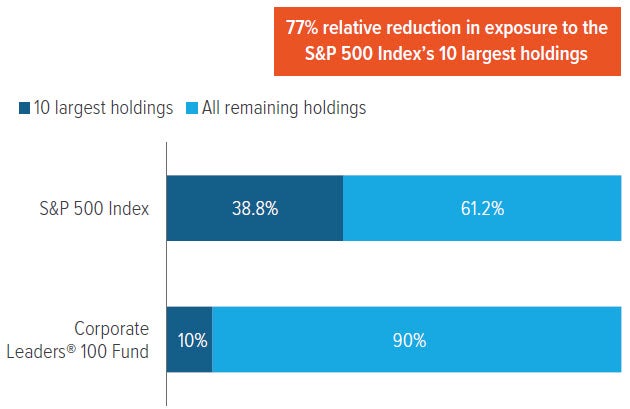
As of 09/30/26. Source: FactSet, Voya IM. An investor cannot invest directly in an index.
Broaden exposure without leaving large-cap leaders behind
The Voya Corporate Leaders® 100 strategy is designed to limit the influence of the largest stocks. The strategy invests across 100 established large-cap companies at approximately equal weights.

Each quarter, its holdings reset to more even weights. The strategy trims positions that have grown larger and adds to those that have moved below their target weight. This rebalancing discipline keeps the portfolio from becoming too dependent on a few stocks as prices move.
A different kind of large-cap core
CL100 can serve as a core large-cap diversifier alongside passive, active growth, and active value strategies. It may complement existing large-cap allocations or replace part of a cap-weighted allocation where holdings overlap.
While Morningstar categorizes the fund as Large Value, its systematic rebalancing discipline can create a value tilt as the strategy trims strength and adds to more attractively valued opportunities. The investment universe and overall portfolio characteristics remain core, making the strategy well suited as a core holding or complement to value, rather than a replacement for dedicated value exposure.
The tradeoff for less concentration
A more balanced allocation won’t lead in every market. The strategy may trail the S&P 500 Index when a small group of the largest stocks drive returns. Its role is to broaden large-cap exposure, not to track the index closely over every period.
Where the strategy may fit
You may find CL100 most useful when your clients’ passive and active large-cap strategies own many of the same companies. This overlap can give a small group of stocks an outsized influence on the overall allocation. CL100 can spread exposure more evenly across established large-cap companies while maintaining exposure to market leaders. The CL100 strategy is available through a mutual fund and a separately managed account (SMA).1 |
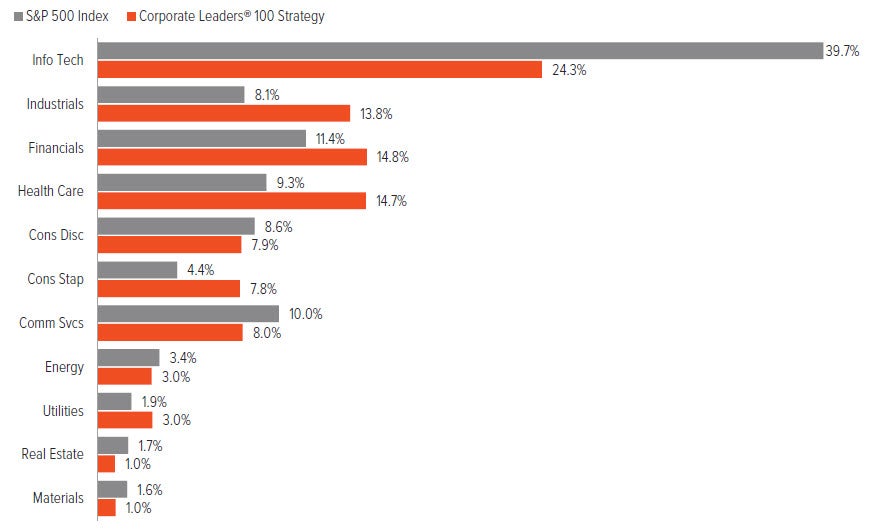
As of 09/30/26. Source: FactSet, Voya IM. An investor cannot invest directly in an index.
A note about risk
All investing involves risks of fluctuating prices and the uncertainties of rates of return and yield inherent in investing. You could lose money on your investment and any of the following risks, among others, could affect investment performance. The following principal risks are presented in alphabetical order, which does not imply order of importance or likelihood: Company; Convertible Securities; Credit; Derivative Instruments; Interest Rate; Investment Model; Market; Market Capitalization; Market Disruption and Geopolitical; Other Investment Companies; Preferred Stocks; Real Estate Companies and Real Estate Investment Trusts; Securities Lending. Investors should consult the Fund’s Prospectus and Statement of Additional Information for a more detailed discussion of the Fund’s risks.