


Higher rates are testing the most rate-sensitive parts of the economy, but they are also restoring income and creating sharper distinctions between risks worth taking and risks best avoided.
Key takeaways
- 5% may be closer to normal than temporary. Structural inflation pressures and rising global yields have changed the starting point for rates.
- Warsh faces a difficult inflation signal. Core PCE and inflation breadth complicate the case for easier policy, even as other inflation measures moderate.
- Not all AI spending responds equally to higher rates. Strategic spending by cashrich hyperscalers is less rate-sensitive than leveraged data centers, neoclouds, and other financing-dependent projects.
- Higher yields improve the return foundation for bonds. Income now provides a larger cushion against rate volatility.
- Credit resilience masks growing dispersion. Tight spreads leave less room for broad gains, while issuer and structure selection matter more.
- Mortgage stress is a warning, not yet a systemic break. Higher rates are pressuring housing and leveraged buyers, but housing is not currently a major engine of economic growth.
- The best opportunities are increasingly specific. Mortgage-related credit, selected corporate dislocations, and carefully structured private-market opportunities offer more potential than broad risk exposure.
Is 5% the new normal?
The rise in long-term yields is not solely a U.S. story. Treasury yields have moved higher alongside rates in other developed markets, reinforcing the case that the post-financial-crisis rate regime has ended.
Several forces are pushing in the same direction: fragmented supply chains, reshoring, lower migration, larger fiscal deficits, higher energy costs, and sustained demand for materials and power. The AI capital-spending cycle adds another source of demand that isn’t especially responsive to modest changes in borrowing costs.
The yield curve has also returned to a more normal, upward-sloping shape after more than two years of inversion. Recent flattening has come mainly from higher front-end rates as the policy-sensitive 2-year Treasury repriced with rising inflation expectations.
The implication is that portfolios should not depend on a rapid return to the low-rate conditions that followed the global financial crisis.
Warsh’s inflation challenge
Inflation is sending conflicting signals. Several measures show disinflation, while core personal consumption expenditures (PCE)—the Fed’s historically preferred gauge—has moved differently.
Part of that divergence reflects the composition of core PCE: Software and related services carry greater weight, giving AI-related price pressures more influence, whereas shelter, which has less emphasis in core PCE, has moderated.
Inflation breadth adds another complication. The share of PCE components running above 3% has eased on shorter lookbacks but remains important to the policy outlook. That matters for Fed Chair Kevin Warsh, who entered the year viewed as inclined toward easier policy. Changing the emphasis among inflation measures may strengthen or weaken the case for a particular decision, but it doesn’t eliminate the underlying pressure.
The result is a less predictable policy path. The Fed may tolerate some commodity- and supply-driven inflation because higher rates cannot directly create power capacity, increase refining capacity, or repair global supply chains. But persistent core inflation still limits its room to ease.
AI spending isn’t equally rate sensitive
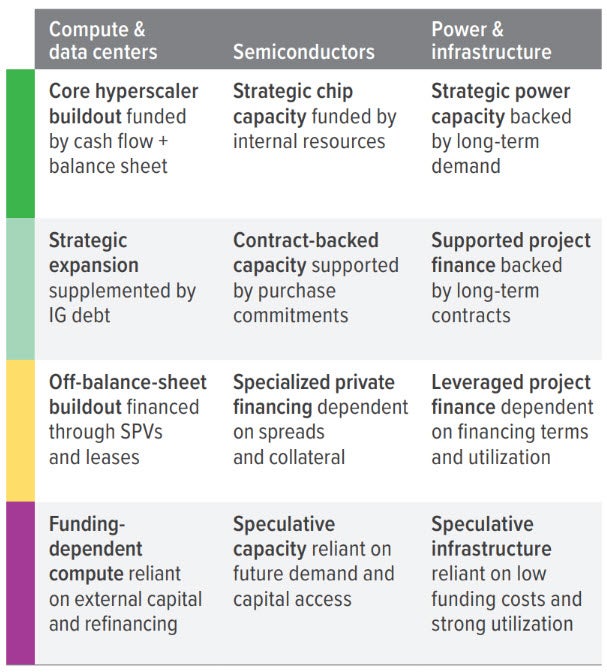
AI capital spending is often treated as a single cycle. It is better understood as several financing channels with very different exposure to higher rates.
Source: Voya IM.
Cash-rich hyperscalers can continue strategic investment even when borrowing costs rise. Their spending is driven by competition, capacity needs, and the risk of falling behind—not simply by the cost of debt. That makes this part of the cycle a persistent source of demand and inflation pressure.
The more leveraged parts of the buildout are different. Data-center developers, neoclouds, commercial real estate structures, and projects dependent on private credit or off-balance-sheet financing face a higher hurdle as rates rise. Their economics depend more heavily on refinancing costs, lease structures, collateral values, and continued access to capital.
This distinction helps explain why higher rates may slow parts of the economy without cooling the strongest sources of AI demand. It also shifts the market question from how large the AI buildout will become to which structures can withstand a higher cost of capital.
Where higher rates are creating stress
Higher rates are beginning to expose vulnerabilities, but the pressure isn’t uniform. Mortgage markets experienced a sharp period of stress as higher yields amplified convexity selling and forced some leveraged buyers to reduce positions. Housing activity is likely to weaken further, although housing is already contributing relatively little to economic growth.
Commercial real estate presents a different pattern from the office- and retail-led stress of recent years. The current problem is increasingly the cost of financing. Good assets can still face pressure when capital structures were built for lower rates or contain too little equity.
Corporate credit remains resilient overall, but tight spreads reduce the margin for error. Higher financing costs and changing business models are creating greater differences among issuers. Returns are therefore more likely to come from income and specific dislocations than from another broad move tighter in spreads.
Portfolio implications
- Use income as the first line of defense. Higher starting yields provide meaningful return potential without requiring aggressive spread compression.
- Keep duration measured, not absent. Avoiding duration entirely could limit participation if long-term yields decline.
- Distinguish strategic AI demand from leveraged AI financing. The same capex cycle creates durable demand in one part of the market and refinancing risk in another.
- Favor specific credit opportunities over broad beta. Tight spreads make security, sector, and structure selection more important.
- Watch mortgage-related credit for dislocations. Rate volatility can create opportunities where underlying cash flows remain sound.
- Treat commercial real estate stress as a capital-structure issue. Financing terms and equity cushions may matter more than property labels.
- Preserve flexibility. Higher volatility can create better entry points across public credit, private credit, and real estate lending.
A note about risk
The principal risks are generally those attributable to bond investing. Holdings are subject to market, issuer, credit, prepayment, extension, and other risks, and their values may fluctuate. Market risk is the risk that securities may decline in value due to factors affecting the securities markets or particular industries. Issuer risk is the risk that the value of a security may decline for reasons specific to the issuer, such as changes in its financial condition. The strategy invests in mortgage-related securities, which can be paid off early if the borrowers on the underlying mortgages pay off their mortgages sooner than scheduled. If interest rates are falling, the strategy will be forced to reinvest this money at lower yields. Conversely, if interest rates are rising, the expected principal payments will slow, thereby locking in the coupon rate at below market levels and extending the security’s life and duration while reducing its market value.