



Stable value funds play a critical role in DC plans, historically providing principal preservation, consistent positive returns, liquidity for benefit payments, and financial confidence for participants.
Why stable value?
Stable value funds have become quite popular in the tax-qualified investment landscape since their introduction 50 years ago, with $861 billion currently invested in the space.1
These funds are structured in a way that guarantees a minimum interest rate and allows participants to access their savings at full value, even when market values fluctuate.
This approach translates into several attractive benefits for current and future retirees.
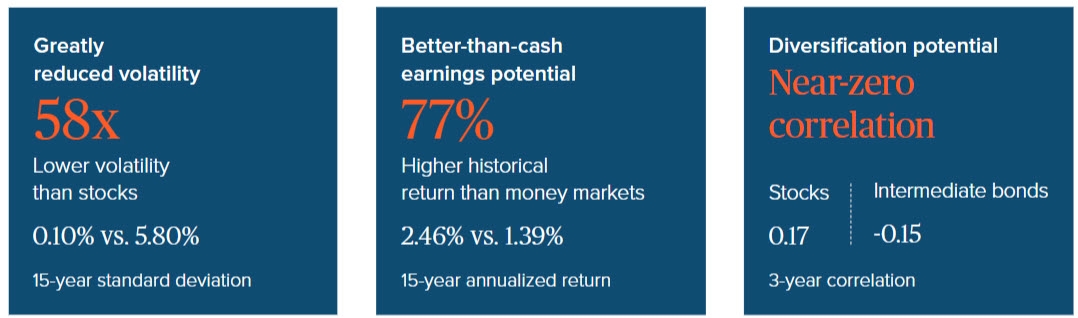
As of 06/30/26. Source: Stable Value Investment Association.
Greatly reduced volatility
Stable value funds are designed to minimize volatility, providing lower risk than stocks, bonds, and even money market funds (see chart). A key contributor to this stability is the wrap component, typically provided by a bank or insurance company, which helps smooth the impact of market volatility.
Better-than-cash earnings potential
Different than the cash-like returns of money markets, stable value funds offer enhanced return potential (see chart). Professional management of a diversified fixed income portfolio has historically helped stable value funds outpace money market returns.
Diversification potential
Low volatility translates to lower correlations with stocks and bonds, leading to improved risk-adjusted returns.1
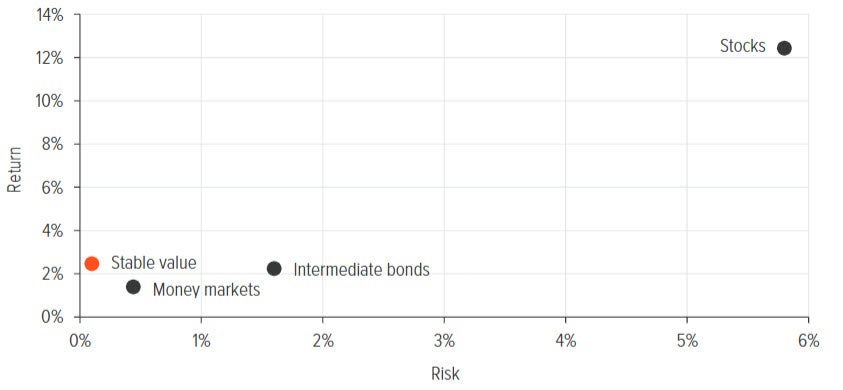
As of 06/30/26. Source: Stable Value Investment Association. Annualized return and standard deviation over 15 years. See back page for index definitions and other disclosures.
Evaluating stable value funds and managers
Selecting investment managers and wrap providers requires careful evaluation, as stable value funds are not one-size-fits-all.
Consider:
- Plan design and how many inactive or retired participants are in the plan
- The experience of the investment manager controlling the underlying investments
- The performance of both the underlying investments and the stable value fund vs. applicable benchmarks
- The credit quality of the underlying investments and the contract issuers
- The termination provisions in the stable value contracts
Putting stable value to work in your plan
Stable value funds have proven to be an appealing option for participants who are risk averse or nearing retirement, offering a compelling combination of benefits and an attractive risk/reward profile.
Now may be a good time to investigate the stable value market to determine how your plan might potentially benefit from the current rate environment. Reach out to your Voya representative to learn more.