


Fixed Income Perspectives: The Fed’s AI Problem

Head of Multi-Sector Fixed Income

Key Takeaways
AI demand is becoming a macro story. The buildout is straining physical inputs such as semiconductors, electricity, metals, water, and specialized labor, creating cost pressures in the near term before longer-term productivity benefits emerge.
AI complicates the Fed’s reaction function. If AI investment proves relatively insensitive to higher rates, the Fed may have to decide whether to suppress demand in other areas of the economy to contain inflationary spillovers.
For fixed income, selectivity is the opportunity. Investors should balance duration, quality, and income, while favoring active sector and security selection over portfolios dependent on a single rate outcome.
Artificial intelligence is overheating one part of the economy. The Federal Reserve can only cool all of it.
When AI demand becomes physical demand
The AI boom is a software cycle inside an infrastructure cycle, each expanding at very different speeds. Scaling the technology means companies must compete for scarce inputs such as advanced chips, copper, power, cooling equipment, water access, and specialized labor.
Several of these inputs are already under cost pressure. Copper prices have spiked since 2020, semiconductor import prices have stopped falling as constraints tighten, and power demand from data centers is rising faster than the grid can easily absorb.
The result is a simple mismatch: AI demand can scale exponentially, while physical supply can take years to adapt.
If the investment boom continues, there’s a risk that cost pressures could spill into other categories even as parts of the economy cool. Over time, AI-enabled productivity should help ease inflation. But the inflation impulse from AI could get worse before it gets better.
A blunt tool for a narrow problem
Our base case remains that inflation stays contained and the Fed keeps rates on hold. But the risk case is that AI-related investment and supply constraints keep certain prices firmer than expected. That leaves the Fed with an awkward problem. Higher rates are unlikely to slow AI investment when the companies driving it are seeing strong earnings growth. Data center and power-generation construction has been rising despite the 2022 rate hikes (Exhibit 1). Instead, the burden of higher rates would fall on more rate-sensitive businesses that are experiencing relatively less momentum.
The Fed could cool the economy, but not necessarily the part that’s creating the heat.
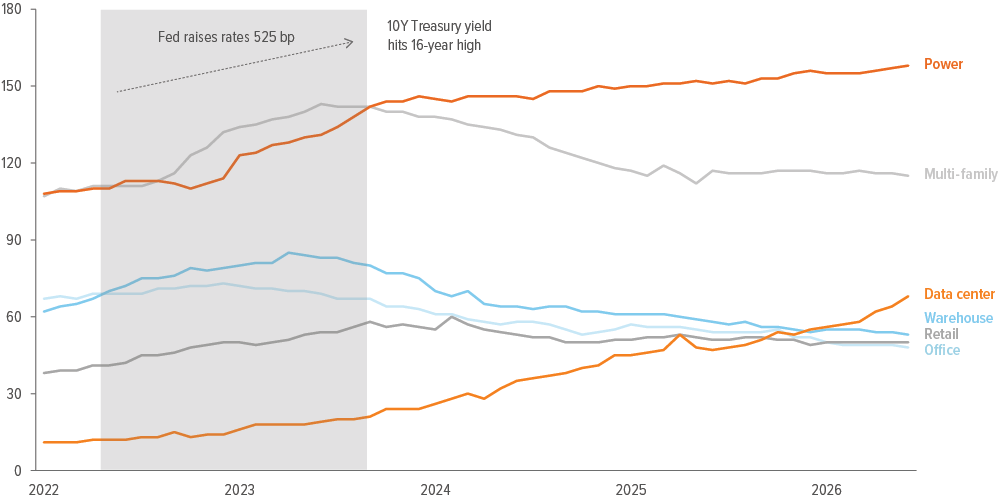
As of 06/30/26. Source: Census.gov, Voya IM.
The Fed is already studying this tension. Its new Productivity and Jobs task force is assessing how AI and other general-purpose technologies affect productivity, employment, and inflation. The group’s mandate reflects the central question: How should policymakers respond when near-term investment demand may be inflationary, but the resulting technology could expand productive capacity later?
With the Fed facing a more complicated inflation signal and providing less forward guidance, the rate path may become harder to anticipate. That puts more weight on portfolios built for balance, resilience, and a wider range of outcomes.
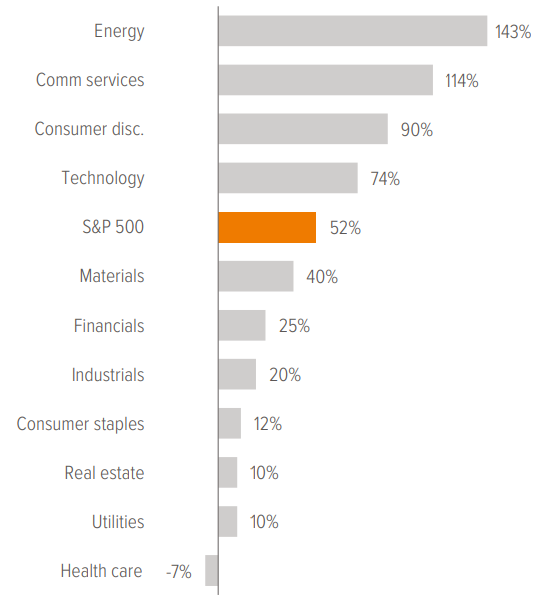
As of 08/21/26. Source: LSEG I/B/E/S. 93% of companies reported.
Selectivity is the opportunity
We generally avoid making portfolio outcomes dependent on a large interest-rate call. Still, duration remains an important lever. With rates currently appearing oversold, we have maintained a modestly longer posture in selected parts of the curve, particularly toward the shorter end.
The larger opportunity is in dispersion. An uneven economy should create wider differences among sectors and issuers. Some businesses will benefit from sustained infrastructure spending. Others will face higher input costs, financing pressure, or weaker demand. Tight credit spreads leave little room for investors to ignore those distinctions.
The main risk is overcorrecting to one macro outcome. Moving heavily into short-duration funds may reduce rate sensitivity, but it can limit participation if yields decline. Reaching into lower-quality high yield may increase income, but it also adds vulnerability if growth weakens.
The better approach, in our view, is staying balanced, maintaining a focus on quality, making sure you’re being compensated for taking risk, and let security selection do more of the work.
Investment takeaways
- Favor selectivity over a broad market call. An uneven economy should produce wider differences across sectors and issuers, increasing the value of security selection and valuation discipline.
- Use duration selectively. Attractive yields and opportunities along the curve support measured interest-rate exposure without making portfolio outcomes dependent on one Fed scenario.
- Balance income with resilience. Consider the risks of going too short to escape rate risk or reaching too far down in quality for yield. We believe a combination of duration, quality, and income can help investors prepare for multiple macro outcomes.
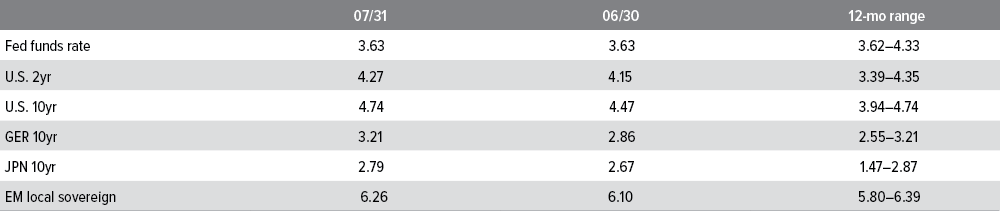
As of 08/26/26. Sources: Bloomberg, J.P. Morgan, Factset, Voya IM. SA: Seasonally adjusted. PCE: Personal consumption expenditures.
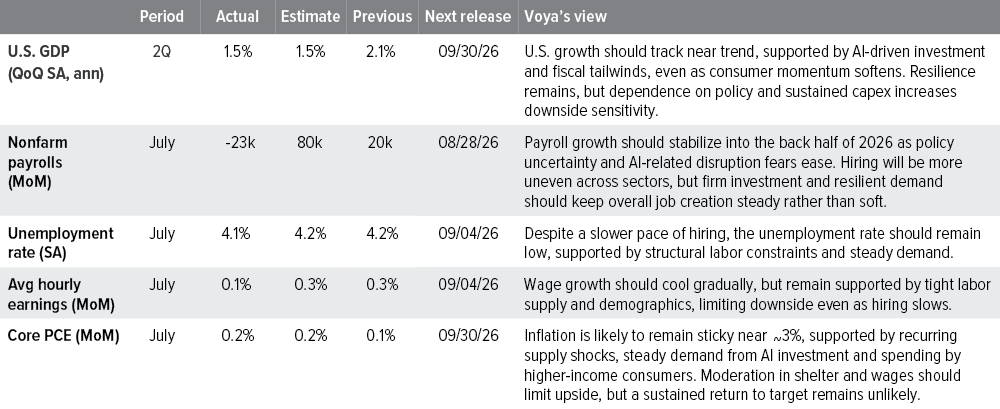
As of 07/20/26. Source: Bloomberg, FactSet, Bureau of Labor Statistics, Voya IM. SA: Seasonally adjusted. PCE: Personal consumption expenditures.
Sector scorecard


- IG corporates remain modestly negative, with July’s widening underscoring how vulnerable tight valuations are to heavy supply, rate volatility, and concentrated technology, media, and telecommunications issuance.
- Fundamentals remain solid, with broad earnings strength and AI-related capital spending supporting growth, but the long end of the curve has been pressured by hyperscaler, data center, and related issuance.
- We still see selective value in hybrids, BBBs, banks, utilities, and attractive new-issue concessions, but broad risk should stay close to index until valuations become more compelling.

- High yield remains neutral, with supportive fundamentals and carry offset by tight valuations and only modest upside from spread compression.
- Corporate fundamentals are still broadly constructive, earnings beats continue to outnumber misses, and defaults remain manageable, but stress is more visible in CCC rated bonds, as well as in cable, chemicals, health care, airlines, and lower-income consumer exposures.
- Positioning should emphasize durable business models, low-BB to mid/high-B risk, and selective carry. We remain underweight vulnerable cyclicals, lower-quality CCCs, structurally challenged media/ cable, telecom, technology, transportation, and energy exploration and production.

- Senior loans remain neutral tactically, with a constructive medium-term backdrop supported by elevated yields, stable fundamentals, favorable technicals, and below-average payment defaults.
- July performance improved as software rebounded and collateralized loan obligation (CLO) demand firmed, but CCCs remained weak, liability-management exercise (LME) activity persists, and AI-related disruption continues to drive dispersion across software and other exposed sectors.
- Positioning should retain an up-in-quality bias, favoring low-BB and mid-single-B risk, while staying underweight high-BBs, CCCs, weaker low-single-B issuers, software, autos, chemicals, consumer discretionary, and media.

- Agency MBS remain neutral tactically and positive strategically, with fundamentals and limited net supply still supportive, but near-term performance remains highly sensitive to rates, volatility, policy headlines, and technical flows.
- Current-coupon spreads widened in July and now sit wider than their 12-month averages, while muted organic supply, low cash-out refinancing, and potential government-sponsored enterprise (GSE) demand provide a medium-term tailwind.
- Key risks include disappointing GSE purchase execution, continued bank and overseas buyer hesitation, Fed reinvestment into Treasuries, large block sales, fast-money activity, and renewed rate-volatility shocks.
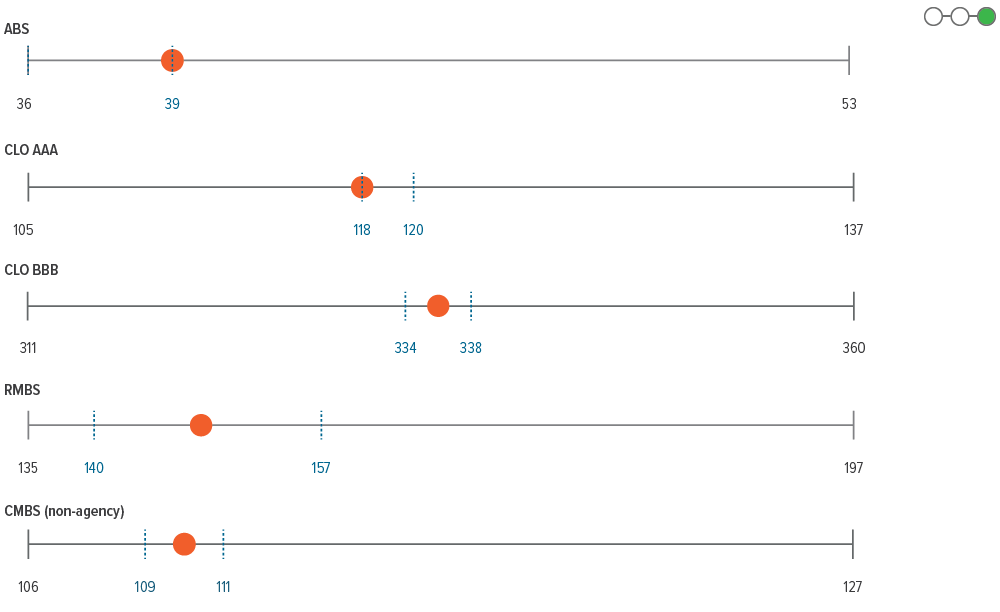
- Securitized credit remains positive overall, but sector dispersion has widened and security selection is likely more important than generalized exposure to the sector.
- Mortgage credit and consumer asset-backed securities remain positive, supported by strong collateral, accumulated home-price appreciation, durable investor demand, slowing supply, and less direct exposure to AI disruption. However, lowerand middle-income consumer stress bears watching.
- CLOs are negative as tight valuations, seasonal liquidity risk, AI-related loan-market uncertainty, and subordinate-credit pressure outweigh strong floating-rate demand and supportive supply dynamics.
- Commercial mortgage-backed securities (CMBS) has been downgraded to negative as tight spreads, a full new-issue pipeline, summer liquidity risk, and bifurcated demand offset reasonable fundamentals and lower direct exposure to AI-related volatility.

- Emerging market hard currency debt remains neutral as spreads remain tight by historical standards, yet geopolitical risk has eased, global growth remains resilient, and most EM central banks retain room to ease.
- July brought modest spread widening, with sovereigns underperforming corporates, while positive fund flows and elevated absolute yields continued to support demand despite limited room for further spread compression.
- Positioning favors corporates and quasis, Latin America, and BBB/BB quality, while remaining underweight sovereigns, cyclical corporates, Asia, GCC exposure, and higher-quality A rated risk.
A note about risk: The principal risks are generally those attributable to bond investing. Holdings are subject to market, issuer, credit, prepayment, extension, and other risks, and their values may fluctuate. Market risk is the risk that securities may decline in value due to factors affecting the securities markets or particular industries. Issuer risk is the risk that the value of a security may decline for reasons specific to the issuer, such as changes in its financial condition. The strategy invests in mortgage-related securities, which can be paid off early if the borrowers on the underlying mortgages pay off their mortgages sooner than scheduled. If interest rates are falling, the strategy will be forced to reinvest this money at lower yields. Conversely, if interest rates are rising, the expected principal payments will slow, thereby locking in the coupon rate at below market levels and extending the security’s life and duration while reducing its market value.