


Fixed Income Perspectives: This Isn’t the Hiking Cycle You Think It Is

Head of Multi-Sector Fixed Income

Key Takeaways
This is a recalibration, not an inflation crackdown. The Fed is taking back last year’s insurance cuts because the economy can stand on its own.
Rates can’t fix a supply problem. Higher borrowing costs won’t build power capacity, produce advanced chips, or reverse geopolitical disruptions, limiting the benefit of additional hikes.
Higher yields create a better bond backdrop. With the economy able to absorb tighter policy and markets already pricing in substantial adjustment, measured duration can offer attractive income and upside if long-term yields fall.
Higher yields reflect a resilient economy, not necessarily the start of a punishing tightening cycle. That could be a favorable backdrop for bond investors.
On September 16, the Federal Reserve raised interest rates for the first time in three years. The impulse is to ask what comes next. Another hike or two? (Probably.) More after that? (Maybe.)
Here’s a more useful question:
Why was the Fed able to cut rates last year, and what changed?
The short answer is the economy didn’t follow the path mapped out for it.
When the Fed was cutting rates a year ago, it expected core inflation would ease and that the rate cuts would help keep a lid on unemployment.
Instead, inflation moved higher, while unemployment actually declined as the labor market stabilized. Consumers proved resilient, productivity growth remained strong, and the wave of capital spending continued. The conditions that justified last year’s cuts never fully materialized. So the Fed is now undoing itself.
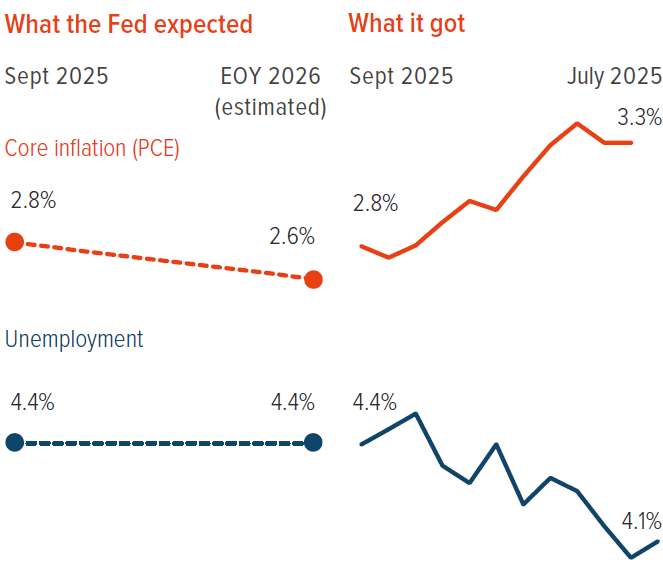
As of 09/22/26. Source: Bureau of Labor Statistics, St. Louis Fed, Federal Reserve Summary of Economic Projections (estimates as of 09/17/25). PCE: personal consumption expenditures; core inflation excludes food and energy. EOY: end of year.
What does the rate hike signal?
It doesn’t necessarily mean inflation has become entrenched or that the Fed must engineer a sharp slowdown.
It suggests the economy no longer needs the same level of policy support.
There is an important difference between tightening policy and removing accommodation:
- Tightening is when the Fed seeks to restrain an overheating economy.
- Removing accommodation recognizes that the economy can stand on its own with less help from the Fed.
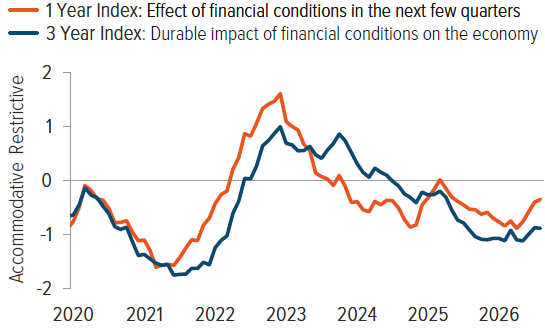
As of 08/31/26. Source: Bloomberg.
We expect the Fed to fully unwind the 75 basis points of cuts delivered last year as it adjusts to an economy that’s more durable than expected.
This month’s surprisingly strong manufacturing PMI report reinforced that point: The economy isn’t slowing enough to bring inflation down naturally. But the details are important: widespread supplier delays, capacity constraints, and rising input costs suggest that much of today’s inflation is supply-driven, which isn’t very sensitive to rates.
Supply-driven inflation limits what higher rates can accomplish
Higher rates can restrain demand, but they’re powerless against supply bottlenecks.
They can’t:
- generate electricity
- expand the power grid
- speed the production of advanced chips
- deter strategic AI spending by companies with strong earnings and deep pockets
They also can’t:
- reopen the Strait of Hormuz
- increase oil supply
- reverse the commodity pressures created by geopolitical disruption
- offset the inflationary effects of tariffs and supply-chain frictions
As we noted last month, the parts of the economy generating the most heat are the hardest for rate hikes to cool. Further tightening could end up slowing the broader economy without directly addressing the source of those pressures.
That’s another reason not to assume this is the start of an aggressive effort to get the economy under control.
A better backdrop for bonds
The Fed may have a couple more hikes to go. But the bond market looks ahead, and the move higher in yields began well before the September decision.
That leaves investors with a more constructive combination: an economy capable of absorbing higher policy rates, and bond yields that have already priced in expectations for additional hikes.
Our positioning reflects that balance:
A. We avoid making portfolio outcomes dependent on a large directional rate call.
B. However, we believe today’s yields support measured duration exposure, alongside an emphasis on quality, sector selection, and income.
C. Moving too far into short-duration assets to avoid rate risk could limit participation if long-term yields decline.
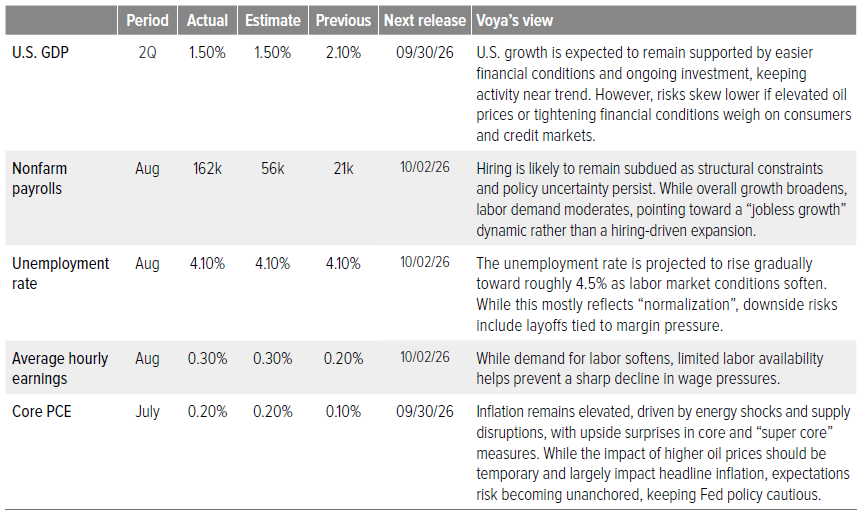
As of 09/23/26. Source: Bloomberg, FactSet, Bureau of Labor Statistics, Voya IM.
Sector scorecard


- Investment grade (IG) corporate spreads are unchanged year to date at 78 basis points (bp) and valuations still not attractive enough to warrant broad risk addition.
- Record August supply of $163 billion capped the late-July rally, and September supply could reach roughly $230 billion, creating near-term risk alongside higher rate volatility after Warsh’s hawkish Jackson Hole remarks.
- We still see selective value in hybrids, BBBs, banks, utilities, TMT/AI capex beneficiaries, and attractive new-issue concessions, but portfolios should stay close to market weight until valuations improve.

- Corporate fundamentals remain strong, supported by healthy earnings growth, improving interest coverage, and successful refinancing activity.
- Investors are reducing tactical risk positions, particularly in single-B credits, after a period of strong performance.
- Security selection is expected to drive future returns more than broad market beta exposure.

- Senior loans are supported by strong technicals, stable fundamentals, below-average payment defaults, and attractive carry.
- August was the second-best monthly return in the past year, helped by a rebound in software loans, a supply shortage, and nearly $20 billion of CLO issuance, though CCC loans remained negative and dispersion stayed high.
- Positioning should retain an up-in-quality bias, favoring low-BB and mid-single-B risk while staying selective around software/SaaS, autos, chemicals, consumer discretionary, media, and weaker low-single-B or CCC issuers exposed to AI disruption or refinancing pressure.

- Agency MBS fundamentals and limited net supply are supportive, but near-term performance is still tied closely to rates and volatility.
- Current-coupon OAS was 1 bp wider at 26, and the Z-spread was 3 bp tighter at 93, with both wider than their 12-month averages. Muted organic supply, low cash-out refinancing, and potential GSE purchase demand remain medium-term tailwinds.
- Key risks include Fed rate-hike rhetoric, renewed rate-volatility shocks, disappointing GSE purchase execution, bank and overseas buyer hesitation, fast-money or REIT selling, and policy headlines.

- Emerging market (EM) hard-currency debt remains tight by historical standards and offer limited room for further tightening, even as resilient global growth and strong demand support carry.
- August spreads tightened modestly by 5-10 bp, with both sovereigns and corporates generating positive excess returns; issuance fell to $10 billion, while EM hard-currency fund inflows rose to $1.2 billion.
- Positioning favors corporates and quasis, Latin America, and BBB/BB quality, while remaining underweight sovereigns, cyclical corporates, Asia, Gulf Cooperation Council exposure, and A rated risk; the main risk is that U.S./Iran tensions reverse improving geopolitics and push EM central banks toward hikes.
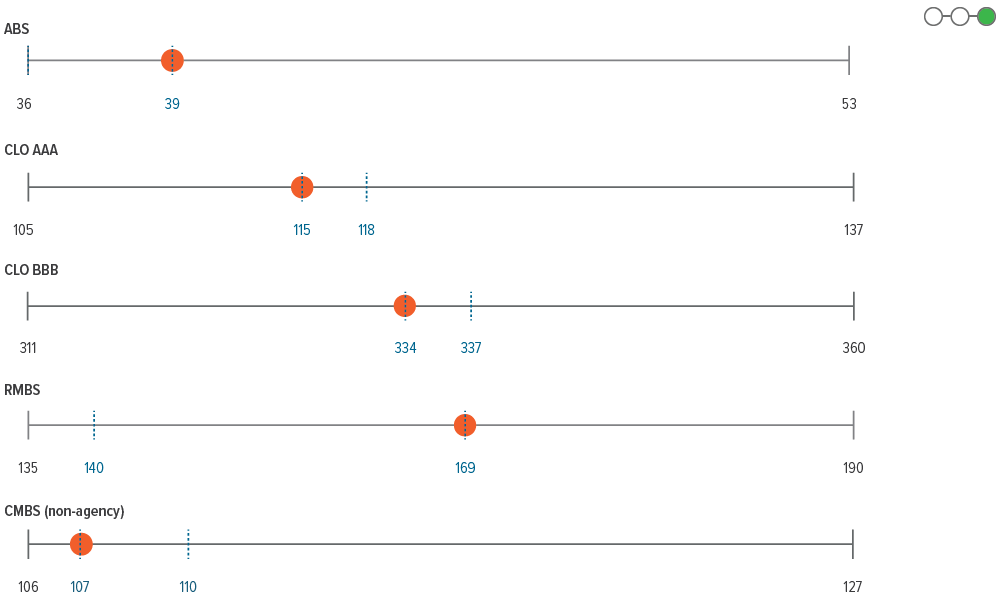
- Securitized credit remains positive overall, led by mortgage credit and consumer ABS, but the sector mix has become more uneven, as CLOs and CMBS remain negative.
- Mortgage credit remains, supported by accumulated home price appreciation, demographics, a roughly 3-million-unit housing shortage, and durable labor market support, though heavy post Labor Day supply and duration headwinds are near-term risks.
- We remain positive on consumer ABS, however, strong risk appetite and resilient labor markets are offset by a post-Labor Day supply surge toward a potential $400+ billion annual record.
- CMBS continues to look attractive strategicly, but a heavy September new-issue pipeline could challenge valuations in the near term.
A note about risk: The principal risks are generally those attributable to bond investing. Holdings are subject to market, issuer, credit, prepayment, extension, and other risks, and their values may fluctuate. Market risk is the risk that securities may decline in value due to factors affecting the securities markets or particular industries. Issuer risk is the risk that the value of a security may decline for reasons specific to the issuer, such as changes in its financial condition. The strategy invests in mortgage-related securities, which can be paid off early if the borrowers on the underlying mortgages pay off their mortgages sooner than scheduled. If interest rates are falling, the strategy will be forced to reinvest this money at lower yields. Conversely, if interest rates are rising, the expected principal payments will slow, thereby locking in the coupon rate at below market levels and extending the security’s life and duration while reducing its market value.