


Fixed Income Perspectives: A More Bond-Friendly Policy Mix Takes Shape

Head of Multi-Sector Fixed Income

There’s more to like about bonds in the post-election landscape, with attractive starting yields and greater potential for price appreciation. But tight credit spreads still warrant a selective approach to risk.
Key takeaways
- Shifting the path, not the direction, of growth. With additional fiscal stimulus unlikely, greater focus on affordability, and uncertainty around AI/data center policy, growth and inflation should cool without putting the expansion at risk.
- Bullish for bonds. Less pressure on yields could benefit duration, while continued economic growth remains supportive of credit.
- More ways for bonds to deliver. Attractive starting yields provide a strong base of income, while potential price appreciation and lower volatility could broaden opportunities across fixed income.
- Securitized stands out. Residential mortgages and consumer asset-backed securities offer particularly favorable hunting grounds for diversifying beyond core fixed income.
A new trajectory takes shape
The election changes the path ahead, but it doesn’t necessarily change the direction of the economy. Divided government makes another major deficit- financed spending push less likely. At the same time, policy shifts related to Iran and tariffs could take some pressure off inflation, while a slower pace of AI investment could temper growth at the margin.
That could be a good mix for bonds. Slower growth and easing inflation could take some pressure off yields, while a still-healthy economy continues to provide support for credit.
A more favorable balance for bonds
There are a lot of moving pieces coming out of the election, but they tend to point in the same general direction: less fiscal support, a concerted effort to bring down costs, and a potentially slower pace of AI investment. That could take some heat out of growth and inflation and help settle rate volatility.
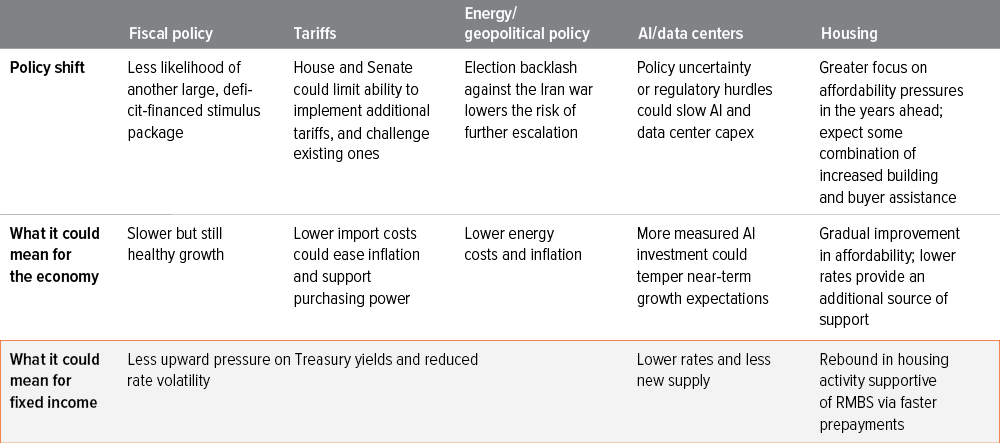
For bonds, three things matter most:
- Growth could cool but not stall: Reduced likelihood of another large, deficit-financed stimulus package and slower AI investment should moderate growth.
- Inflation and rates could move lower: Shifts in Iran policy and tariffs could ease inflation pressures. Combined with softer growth, this should lead to lower interest rates.
- Lower rates and inflation could unlock other growth drivers: Lower rates could support a housing recovery, while easing inflation could bolster consumer spending, helping partially offset weaker contributions from fiscal stimulus and AI investment.
Together, that mix could deliver an improved balance: growth strong enough to support credit, but not so strong that it continues to push inflation and interest rates higher.
Putting the new backdrop to work
Today’s yields already give bonds a solid starting point. Rates don’t have to fall for bonds to deliver attractive returns. The bigger question is where we see the best opportunities from here.
Credit still has support, but selectivity matters. A healthy economy is good for credit spreads, but valuations matter. With less room to tighten from current levels, spreads could be more vulnerable if growth slows more sharply than expected.
Securitized stands out. This is one area where we see particularly attractive opportunities. Mortgage credit continues to benefit from built-up equity, a housing shortage of roughly 3 million units, and limited new supply. Consumer asset-backed securities also look attractive, as a healthy labor market supports borrowers, although pressure on lower-income consumers requires selectivity. Agency mortgages could benefit as well if calmer rates create a more stable environment for the sector.
AI could create an opportunity in investment grade credit. If greater scrutiny slows some data center projects, companies may not need to borrow as much to fund construction. That means fewer new bonds being issued, easing a supply headwind that has weighed on the market. Limits on new development could also make existing data center capacity more valuable, creating idiosyncratic opportunities.
Duration looks more attractive. Some of the forces that pushed growth and yields higher could reverse. That gives investors attractive income today, with additional return potential if rates move lower.
So, the opportunity isn’t just about locking in today’s yields. A more favorable rate environment, a still-healthy economy, and distinct opportunities across credit and securitized markets could give bonds more ways to deliver.
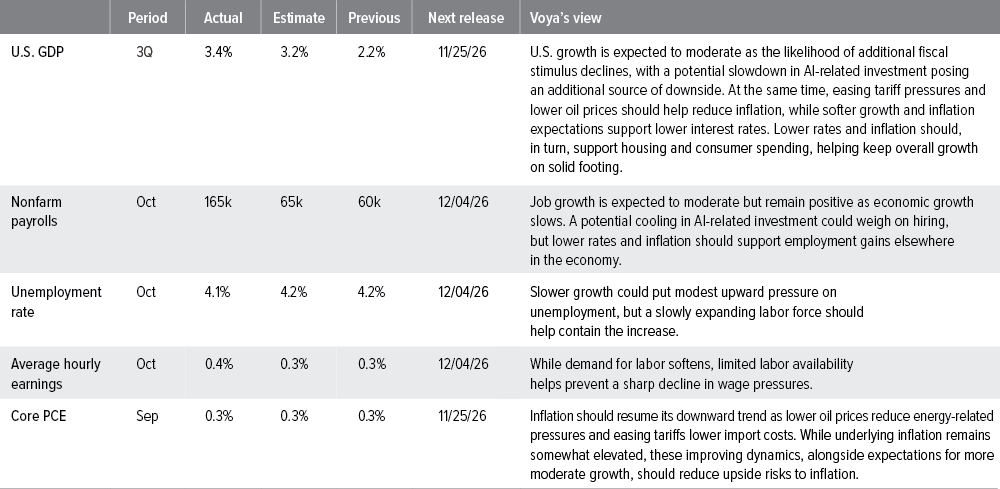
As of 11/09/26. Source: Bloomberg, FactSet, Bureau of Labor Statistics, Voya IM.
Sector scorecard
Credit spreads represent the extra yield over the 10-year Treasury.


- Investment grade (IG) corporate bonds improved to neutral, looking more attractive after October’s spread widening and creating opportunities to selectively add back risk.
- October supply of $125 billion bested expectations as late month hyperscaler deals surprised the market.
- We still see selective value in hybrids, BBBs, banks, and TMT/AI-capex beneficiaries, and portfolios took advantage of attractive new issuance to add risk as spreads widened.

- High yield remains neutral, with supportive fundamentals and carry offset by tight valuations.
- Corporate fundamentals are still broadly constructive, earnings beats continue to outnumber misses, and defaults remain manageable, but stress is more visible in CCCs, cable/satellite, certain consumer and cyclical credits, and lower-income consumer exposures.
- Positioning should emphasize durable business models, low-BB to mid/high-B risk, and selective carry, while remaining underweight vulnerable cyclicals, lower-quality CCCs, structurally challenged media/cable, telecom, technology, transportation, and energy E&P.

- Senior loans remain constructive, supported by strong technicals, stable fundamentals, below- average payment defaults, and attractive carry, but tight valuations are challenging.
- October delivered a negative return, under pressure alongside broader markets, as sentiment weakened given concerns with AI-related supply indigestion, higher oil prices, and elevated inflation. CLO issuance remained healthy at $12.6 billion, though CCC loans remained negative and dispersion stayed high.
- Positioning should retain an up-in-quality bias, favoring low-BB and mid-single-B risk while staying selective around software/SaaS, autos, chemicals, consumer discretionary, media, and weaker low- single-B or CCC issuers exposed to AI disruption or refinancing pressure.

- Agency MBS remained modestly positive tactically, though spreads tightened slightly.
- Current-coupon OAS was 5 bp tighter at 28 and ZV was 1 bp wider at 110, with both wider than their 12-month averages; muted organic supply, low cash-out refinancing, and potential GSE purchase demand remain medium-term tailwinds.
- Key risks include a resumed Treasury selloff, renewed rate volatility shocks, disappointing GSE purchase execution, bank and overseas buyer hesitation, fast- money or REIT selling, and policy headlines.
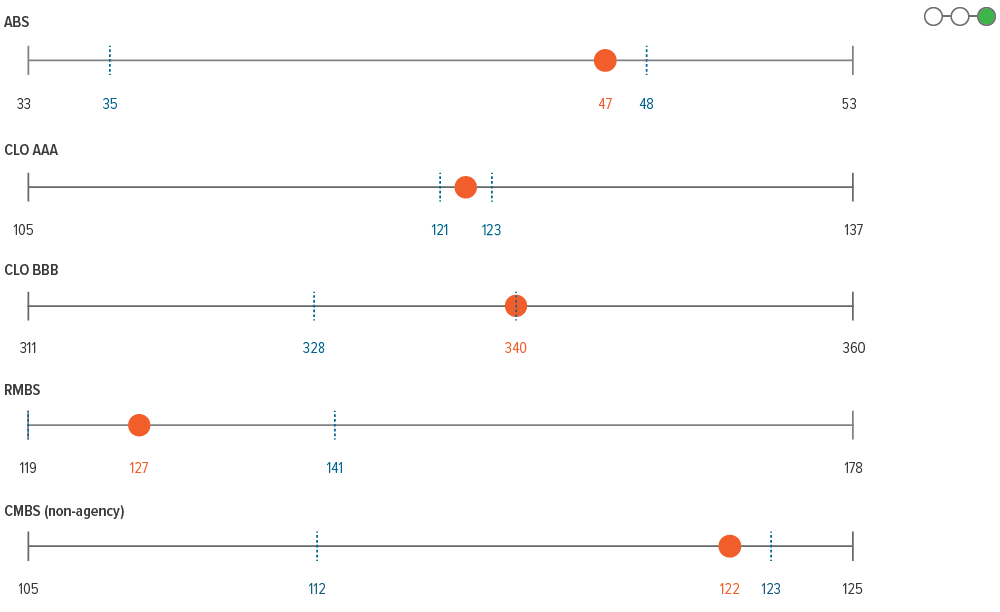
- Securitized credit remains positive overall, led by mortgage credit and consumer ABS.
- Mortgage credit remains positive, supported by accumulated home price appreciation, demographics, a roughly 3-million-unit housing shortage, and durable labor market support, while improving valuations and a shrinking forward supply pipeline strengthen the near-term setup.
- Consumer ABS remains positive, as strong risk appetite and resilient labor markets are supported by technicals that absorbed the post-Labor Day supply surge. Stress on lower-income consumers requires selectivity.
- CLOs remain mixed, with tight IG tranche valuations and AI/SaaS disruption risk offset partly by strong floating-rate demand and supportive technicals.
- CMBS could be pressured by elevated rates, but early cycle dynamics and the lack of new property type stress should limit the overall impact.

- Emerging market hard currency debt remains neutral, as tight spreads are offset by resilient global growth and elevated absolute yields.
- October spreads widened by 30 bp for corporates and 20 bp for sovereign, but they remain near historically tight levels.
- Positioning favors corporates and quasis, Latin America, and BBB/BB quality, while remaining underweight sovereigns, cyclical corporates, Asia, GCC exposure, and A-rated risk; the main risk is that higher U.S. real rates, a stronger dollar, and a more hawkish Fed overshadow solid EM fundamentals.
A note about risk: The principal risks are generally those attributable to bond investing. Holdings are subject to market, issuer, credit, prepayment, extension, and other risks, and their values may fluctuate. Market risk is the risk that securities may decline in value due to factors affecting the securities markets or particular industries. Issuer risk is the risk that the value of a security may decline for reasons specific to the issuer, such as changes in its financial condition. The strategy invests in mortgage-related securities, which can be paid off early if the borrowers on the underlying mortgages pay off their mortgages sooner than scheduled. If interest rates are falling, the strategy will be forced to reinvest this money at lower yields. Conversely, if interest rates are rising, the expected principal payments will slow, thereby locking in the coupon rate at below market levels and extending the security’s life and duration while reducing its market value.