


International small caps offer real opportunity—but navigating 4,000+ companies across dozens of markets takes more than an index. Here are three reasons why active management matters in this area of the market.
Most international equity portfolios are built around the same few hundred large, well-known global companies. It’s a familiar approach, but familiar has a cost. The broader international market, particularly at the smaller end, holds thousands of companies that most investors never consider.
International small caps aren’t just a diversification add-on. They offer exposure to businesses earlier in their growth cycle, in markets and industries that large cap indexes simply don’t reach. But this part of the market rewards a different kind of investing. Companies are smaller, information is less consistent, and results can vary sharply. The investors best positioned to capture the opportunity are the ones equipped to navigate the complexity.
Here are three reasons why active management can make a meaningful difference in international small caps.
1. Size creates room for discovery
The international developed small cap market encompasses more than 4,0001 companies spanning dozens of countries and industries. By comparison, the international developed large cap market contains roughly 700. That difference in scale matters more than it might seem.
In large cap markets, companies are widely covered by investment analysts and, as a result, tend to be more efficiently priced. There is less room to find something the market has missed.
The smaller end of the market works differently. Many international small cap companies are unfamiliar to U.S. investors, lightly followed by Wall Street (if at all), and poorly understood outside their home markets — even when they play significant roles in their local economies.
That also makes a passive approach to this space genuinely difficult. An index tracking 4,000+ companies across dozens of markets treats every stock the same, regardless of quality, liquidity, or how well understood a company actually is. For active managers who can evaluate individual businesses, understand local market dynamics, and identify companies the broader market has overlooked, that complexity becomes an advantage rather than an obstacle.
Exhibit 1 shows that international small-cap equity indexes have consistently ranked in the lower half of Morningstar’s category rankings relative to other major equity asset classes. These results highlight the challenges passive index strategies have faced in this segment of the market.
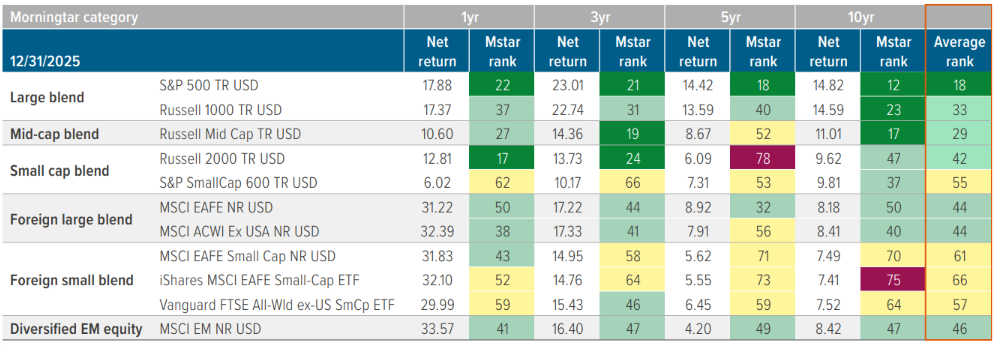
As of 12/31/25. Source: Morningstar, Voya IM. Morningstar is commonly used for calculating an investment’s total return percentile rank against others in its Morningstar Category. With this method, percentile ranks always range from 1 (best) to 100 (worst) with all intermediate values spread evenly over that range. The MSCI EAFE Index measures the performance of large and mid cap stocks across 21 developed market countries, excluding the U.S. and Canada. The MSCI EAFE Small Cap Index measures the performance of small cap stocks across 21 developed market countries, excluding the U.S. and Canada. See back page for other index definitions. Past performance does not guarantee future results. Investors cannot invest directly in an index.
2 Independent research can uncover what the market has missed
Scale alone doesn’t create opportunity, but limited research coverage can. Unlike large, well-known companies that are tracked by dozens of investment analysts, many international small caps stocks receive little attention. Some have no regular coverage at all.
When fewer analysts are watching, stock prices are slower to reflect what’s really happening inside a business— positive or negative. That lag creates specific, identifiable gaps between a company’s price and its actual worth.
Active managers who conduct their own research are positioned to find those gaps before the broader market catches up, and to avoid the pitfalls that go unexamined in a less-scrutinized corner of the market.
Exhibit 2 shows the degree to which international small cap stocks are under-covered relative to other market segments, and why independent research can make a meaningful difference in this space.
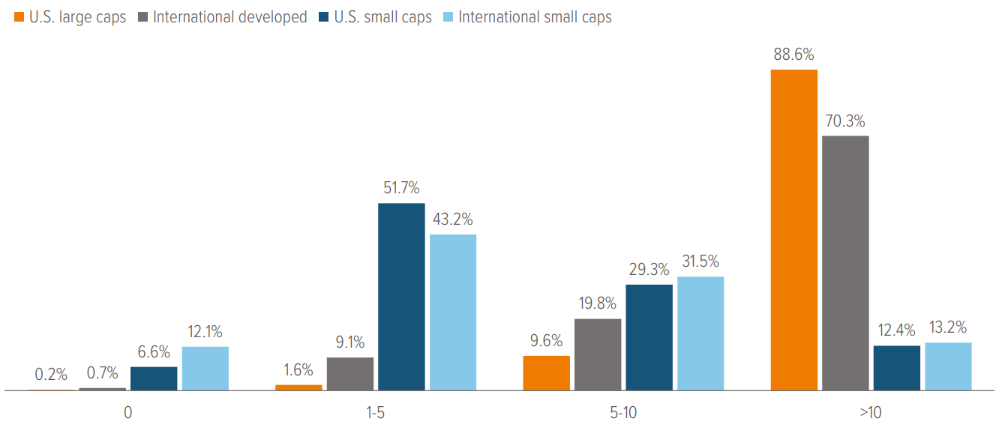
As of 12/31/25. Source: FactSet. X axis represents percentage of broker-dealer analysts providing earnings estimates. U.S. large cap equities represented by the S&P 500 Index. International developed equities represented by the MSCI EAFE Index. U.S. small cap equities represented by the Russell 2000 Index. International small cap equities represented by the EAFE Small Cap Index. Investors cannot invest directly in an index.
3 When results vary widely, skillful stock selection matters more
In international small caps, individual stock results often differ sharply from one another. Some companies perform very well. Others fall behind. This wide range of outcomes is known as dispersion.
When dispersion is higher, investment decisions tend to matter more. Choosing stronger companies—and avoiding weaker ones—can have a larger impact on results than in markets where stocks move more closely together.
Exhibit 3 illustrates how uneven results can be in this part of the market. Bigger gaps can make index-only exposure feel bumpier, but they can also create more room for active managers to add value through stock selection and risk control.
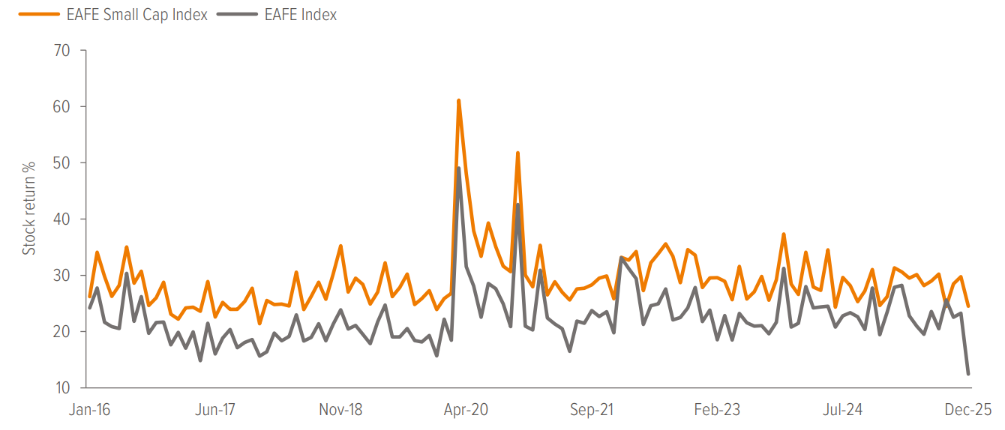
As of 12/31/25. Source: FactSet, Voya IM. Performance dispersion is the range of returns for a group of investments over a period of time. It can be used to measure the risk of an investment and the opportunity for picking stocks that outperform the market. Past performance does not guarantee future results. Investors cannot invest directly in an index.
Why active management can make a difference International small caps are not an easy market to navigate. Companies are smaller, information is harder to come by, and results can swing dramatically from one business to the next. An index cannot do the work of understanding what it owns. In this part of the market, that distinction matters. For investors who understand those realities going in, the three factors outlined in this paper—opportunity set, analyst coverage, and outcome dispersion—are worth weighing carefully when evaluating how to access this part of the market.
Why active management can make a differenceInternational small caps are not an easy market to navigate. Companies are smaller, information is harder to come by, and results can swing dramatically from one business to the next. An index cannot do the work of understanding what it owns. In this part of the market, that distinction matters. For investors who understand those realities going in, the three factors outlined in this paper—opportunity set, analyst coverage, and outcome dispersion—are worth weighing carefully when evaluating how to access this part of the market. |
A note about risk
All investing involves risks of fluctuating prices and the uncertainties of rates of return and yield inherent in investing. The principal risks are generally those attributable to investing in stocks and related derivative instruments. Holdings are subject to market, issuer and other risks, and their values may fluctuate. Market risk is the risk that securities or other instruments may decline in value due to factors affecting the securities markets or particular industries. Issuer risk is the risk that the value of a security or instrument may decline for reasons specific to the issuer, such as changes in its financial condition. Smaller companies may be more susceptible to price swings than larger companies, as they typically have fewer resources and more limited products, and many are dependent on a few key managers. International investing does pose special risks, including currency fluctuation, economic and political risks not found in investments that are solely domestic. Risks of foreign investing are generally intensified for investments in emerging markets.