


Long-term returns are the product of a disciplined investment process: acquiring quality assets at attractive prices, supporting value creation, converting gains into realized proceeds, and reinvesting that capital across a diversified portfolio. Understanding how a private equity secondaries fund moves through that cycle can provide insight into its approach to seeking consistent long-term results.
Three ways secondaries generate returns
Understanding the three phases of a private equity (PE) secondaries investment helps explain how a fund’s returns are generated—and, more importantly, whether they are repeatable.
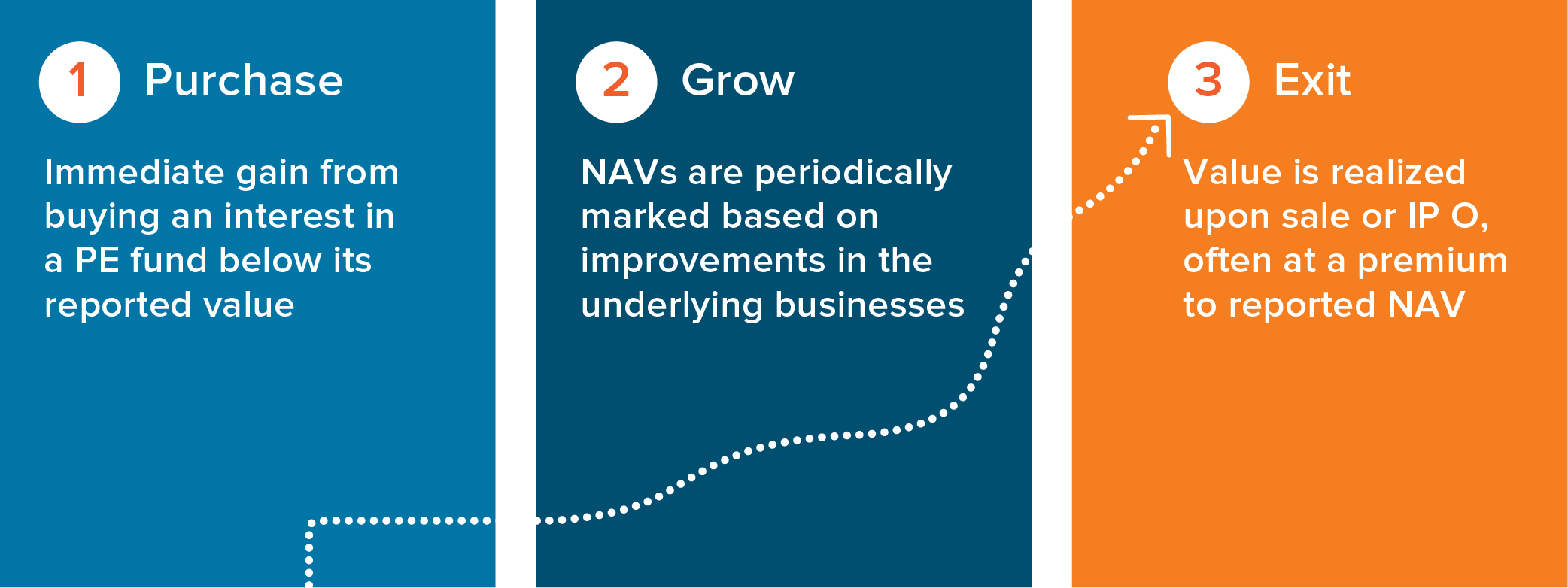
1. Purchase: Buy at a discount
A secondaries fund buys an existing PE interest, typically for less than the net asset value (NAV) reported by the underlying manager, creating an immediate one-time uplift. If that fund pays $87 and then marks it to the $100 reported NAV, it records an unrealized gain of $13.1 Price is an important starting point, but it is only part of the investment case. A large discount may reflect weaker assets, uncertain exit prospects, or limited buyer demand.
The real opportunity lies in acquiring quality assets at an attractive price, with clear potential for growth and realization.
2. Grow: Grow through the holding period
Asset quality becomes increasingly important after purchase, as further returns depend on the performance of the underlying companies. A fund’s general partner (GP) works with management to grow earnings, pay down debt, and strengthen the company’s competitive position. These efforts may increase the holding’s value, supporting growth in the NAV of the private equity interest.
This is the core of long-term value creation: the underlying companies become more valuable over the course of the investment.
2. Exit: Turn unrealized value into cash
When an underlying company is sold or taken public, the exit converts an estimated value into actual proceeds. Quality companies often exit at more than their carrying value, resulting in a final valuation uplift.
This is when the return moves from reported value to realized value. The resulting proceeds can be reinvested into new opportunities or distributed to investors.
Why PIF’s strategy fits an evergreen structure
Long-term return generation in an evergreen PE secondaries fund depends on more than simply acquiring assets at a discount. It requires a strategy designed to identify quality investments, create value through the holding period, and convert that value into realized proceeds that can be reinvested.
Pomona Investment Fund’s (PIF) evergreen structure supports that objective through disciplined underwriting and diversified portfolio construction, with multiple sources of return and liquidity intended to keep capital working across market cycles.
1. Buy quality, not simply the biggest discount
A deep discount can be appealing, but it may also signal lower-quality assets or a less certain path to realization. PIF seeks attractive entry prices while carefully assessing the quality and potential growth of the underlying investments. Pomona’s experience, reputation, and relationships can provide access to high-quality assets at favorable prices, with the goal of capturing the value at purchase and capitalizing on the potential growth over the holding period.
Question to ask: Did the manager acquire high-quality assets at an attractive price, or did it prioritize the largest available discount without sufficient regard for asset quality?
2. Diversify the paths to return and liquidity
A portfolio that’s diversified across funds, companies, industries, vintages, and managers helps reduce reliance on any single investment or exit. Within an evergreen structure, this breadth can support long-term capital appreciation while providing multiple sources of proceeds to meet ongoing liquidity needs.
Question to ask: Is there concentrated exposure that could lead to outsized risk within the portfolio?
3. Build multiple sources of cash flow
PIF can draw on net investor flows, distributions and exits from underlying investments, and, when appropriate, asset sales. No single source is expected to carry the full burden of supporting the evergreen structure.
Question to ask: What is the expected timing of exits, distributions, and other potential cash flows?
4. Underwrite the exit, not just the entry
PIF evaluates each opportunity for its return potential and its path to liquidity. Before we make an investment, we consider the expected timing and visibility of exits, distributions, and other cash generating events.
Question to ask: Has the manager been able to convert reported value during the holding period into exits and cash distributions?
5. Complete the return cycle
The goal is not simply to buy at a discount and report an early uplift. It’s to create value through the full cycle of investment—building a virtuous cycle of momentum. Over time, discounted purchases and unrealized appreciation should give way to exits, distributions, and realized cash. PIF’s evergreen edge is its ability to keep that cycle working across a broadly diversified portfolio.
Question to ask: How much performance came from discounts at purchase, appreciation during the holding period, and valuation uplift when companies were sold?
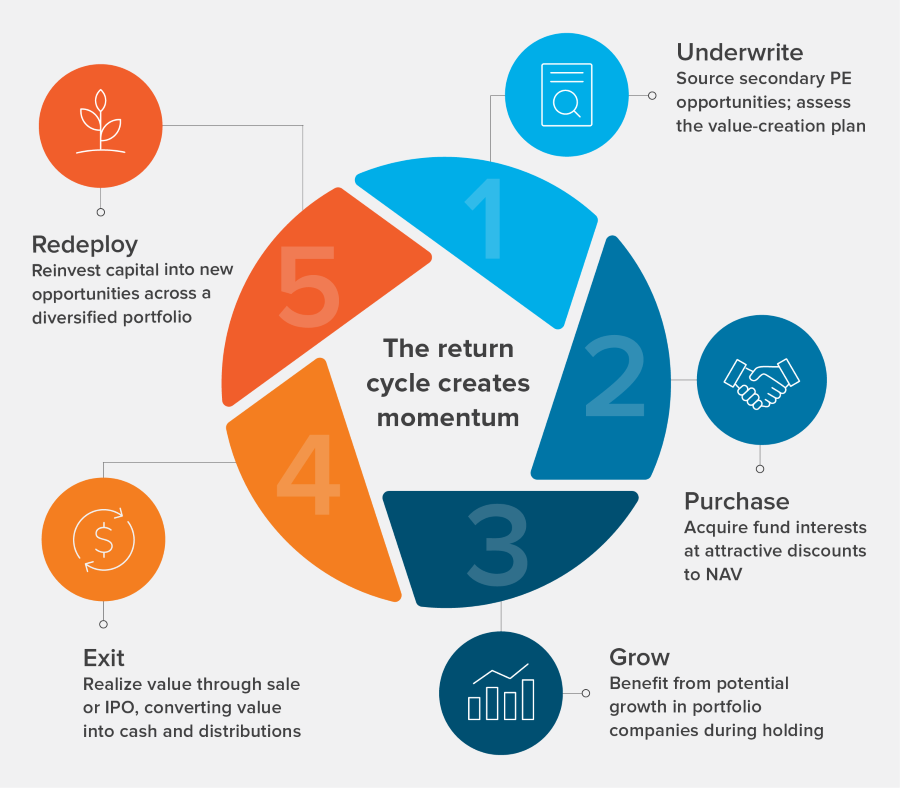
The true measure of an evergreen secondaries strategy is whether the manager can repeatedly buy quality assets at disciplined prices, create and realize value, generate liquidity, and put the capital back to work.
To learn more about the process behind Pomona Investment Fund, please contact your Voya representative.
A note about risk
General private equity risks: Private equity investments are subject to various risks. These risks are generally related to: (i) the ability of the manager to select and manage successful investment opportunities; (ii) the quality of the management of each company in which a private equity fund invests; (iii) the ability of a private equity fund to liquidate its investments; and (iv) general economic conditions. Private equity funds that focus on buyouts have generally been dependent on the availability of debt or equity financing to fund the acquisitions of their investments. Depending on market conditions, however, the availability of such financing may be reduced dramatically, limiting the ability of such private equity funds to obtain the required financing or reducing their expected rate of return. Securities or private equity funds, as well as the portfolio companies these funds invest in, tend to be more illiquid and highly speculative. Primary investment: Risks include the ability to identify sufficient investment opportunities, blind pool, the manager’s ability to select and manage successful investment opportunities, the ability of a private equity fund to liquidate its investments, diversification, and general economic conditions. Secondary investment: Risks include the ability of the manager to select and manage successful investment opportunities, underlying fund risks, limited ability to influence underlying GPs and their respective underlying companies, no established/public market for secondaries transactions, ability to identify sufficient investment opportunities, and general economic conditions, among others.