


Stability Scarcity: Why Markets Are Paying More for Predictable Cash Flows

Head of Value

After years of volatility and uncertainty, markets appear to be entering a phase where dependable cash flows, income, and predictability are increasingly valued as assets in their own right. These companies are historically cheap, increasingly scarce, and, in our view, ripe for meaningful relative revaluation.
The changing macro landscape…
Price pressures have proven more persistent than many expected, but recent developments suggest that concerns about a renewed inflation surge may be easing. One important driver is the growing expectation that artificial intelligence (AI) will support productivity gains over time. Even before these gains appear clearly in labor markets or company pricing behavior, shifting expectations around AI-driven efficiency are influencing views on inflation and interest rates, pulling forward the prospect of disinflation sooner than many had anticipated.
This backdrop supports parts of the equity market tied to productivity-led growth. Industrials, for example, stand to benefit from improved efficiency, while interest rate-sensitive sectors such as housing may respond favorably if long-term rates continue to ease. These areas benefit from lower discount rates and improved operating leverage.
At the same time, this environment introduces a different kind of uncertainty. As technological disruption becomes more definitive, companies whose valuations rely heavily on earnings far into the future face a wider range of possible outcomes. When confidence about long-term projections weakens, markets tend to place greater value on what can be seen and measured today, rather than on assumptions that extend far ahead.
…is shifting market behavior…
This shift in preference is increasingly evident in market behavior. Stability is being rewarded, even as investment in AI continues to accelerate. Defensive and stable value assets have led—not because growth opportunities have disappeared, but because the range of potential growth outcomes has widened. When the future feels less predictable, investors gravitate toward businesses and assets that offer clarity and consistency.
Most recently, the market has rewarded high dividend-paying companies for their predictable cash streams (see chart). Their appeal reflects not only income demand, but also the visibility of near-term cash flows in an environment where long-range forecasts feel less certain.
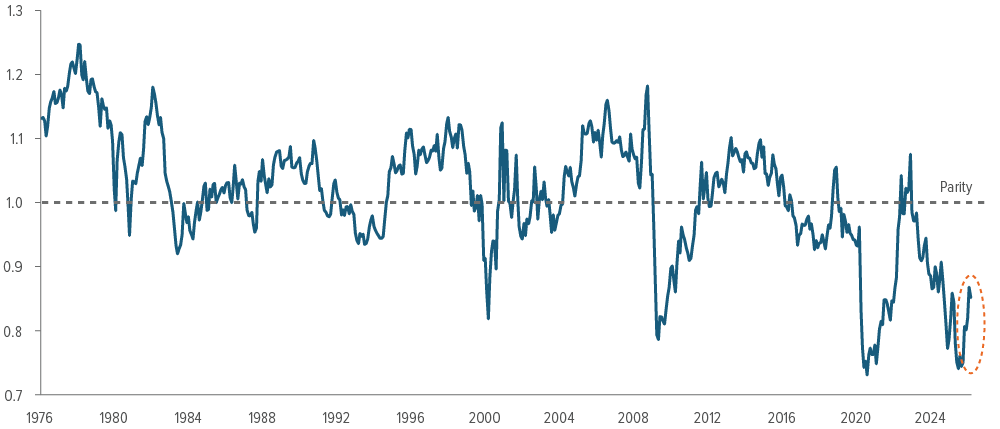
As of 02/26. Source: Empirical Research Partners analysis. The chart shows the capitalization-weighted relative forward P/E ratios from 1976 through early February 2026.
Falling long-term rates and a flattening yield curve reinforce this trend. In this environment, predictable income and steady cash flows become more valuable, because they reduce uncertainty. Predictability, in this sense, carries a premium, as investors place greater emphasis on visibility and reliability. Stability, in other words, has become scarce.
…benefiting specific value sectors
This predictability premium helps explain renewed interest in areas traditionally associated with reliability. Consumer staples, real estate, select parts of health care, and regulated utilities stand out, not for rapid growth but for their ability to deliver consistent results across a range of economic conditions. Their appeal lies in visibility— cash flows that are easier to forecast and business models less sensitive to sudden shifts in growth expectations.
In today’s environment, growth still matters and innovation should not be ignored. However, markets are becoming more selective about how they reward risk. As the economy adjusts to new technology, changing productivity expectations, and evolving policy dynamics, predictability is no longer just a defensive attribute; it is, increasingly, a feature that markets should value more highly.
A note about risk: The principal risks are generally those attributable to investing in stocks and related derivative instruments. Holdings are subject to market, issuer and other risks, and their values may fluctuate. Market risk is the risk that securities or other instruments may decline in value due to factors affecting the securities markets or particular industries. Issuer risk is the risk that the value of a security or instrument may decline for reasons specific to the issuer, such as changes in its financial condition.