


Voya Growth Builder Commentary - 3Q26
Market environment
Rising oil prices and bond yields challenged markets during the quarter. The war in the Middle East added to inflation worries, and the Federal Reserve raised rates in September, signaling that monetary policy could stay tight. For investors, stronger earnings were not enough to lift every part of the market. Higher rates put pressure on stock valuations, while higher fuel and mortgage costs weighed on American consumers.
U.S. large-cap stocks outperformed small caps as investors favored companies with steady cash flow, strong balance sheets, and less dependence on borrowing. Energy stocks benefited from rising oil prices. Software stocks rose, while semiconductor stocks weakened as investors questioned the pace of corporate spending on AI. Earnings expectations improved, but valuation pressure hurt smaller companies. International and emerging-market performance was mixed, with results varying widely by country.
Bonds also struggled as U.S. Treasury yields rose sharply. Core bonds and inflation-protected bonds lost value because the impact of higher rates outweighed the income they produced. Shorter-term bonds held up better. High-yield bonds and leveraged loans also fared better within fixed income because they offered more income and were less sensitive to rate moves. Listed real estate fell as higher rates raised borrowing costs and pressured property values.
Performance review
The Voya Growth Builder Portfolios had mixed results during the quarter, with outcomes largely tied to each Portfolio’s asset mix. Growth-oriented Portfolios held up better than more conservative Portfolios as equities outpaced fixed income. The Portfolios’ overweight to equities versus bonds helped relative performance, as did the underweight to U.S. small-cap stocks, which fell after a strong first half of the year. Stronger economic growth and company earnings supported U.S. large-cap stocks, even as higher rates made the market harder to navigate. Smaller companies were under more pressure because they often rely more on debt financing. The Portfolios’ mid-cap overweight slightly detracted. The underweight to high-yield bonds was also a minor drag because high yield held up better than investment-grade bonds, despite posting negative returns.
Manager selection detracted overall, although several managers added value. MFS Growth (MFEIX) helped through strong stock selection in Health Care and Consumer Discretionary. Columbia Contrarian Core (SMGIX) also contributed, supported by stock selection in Information Technology and Consumer Discretionary, exposure to select Magnificent Seven holdings, and underweights to Utilities and Consumer Staples. GQG Partners International Opportunities (GSINX) benefited from defensive positioning and Information Technology exposure, while T. Rowe Price Capital Appreciation (PRWCX) also added to performance. Voya Large Cap Value Fund (IEDIX) detracted, mainly due to weak stock selection in Information Technology and Industrials, as well as an unfavorable underweight to Information Technology. In fixed income, Fidelity Advisor Total Bond (FEPIX), Voya Intermediate Bond (IICIX), and Columbia Core Bond ETF (CRUX) modestly detracted as slightly long duration hurt returns when rates rose. JPMorgan Core Bond (WOBDX) was broadly in line with its benchmark.
Investment outlook
The U.S. economy is still growing, but borrowing money has become more expensive. Spending on AI, energy security, defense, and bringing supply chains closer to home should support investment. At the same time, sticky inflation, large government deficits, and resilient growth are keeping bond yields elevated. For investors, this means cash and bonds can offer more income than they did in recent years, but higher rates also make it harder for stocks and real estate to rise. U.S. consumers remain resilient, and the labor market is steady, but risks from energy, trade, and geopolitics leave less room for error.
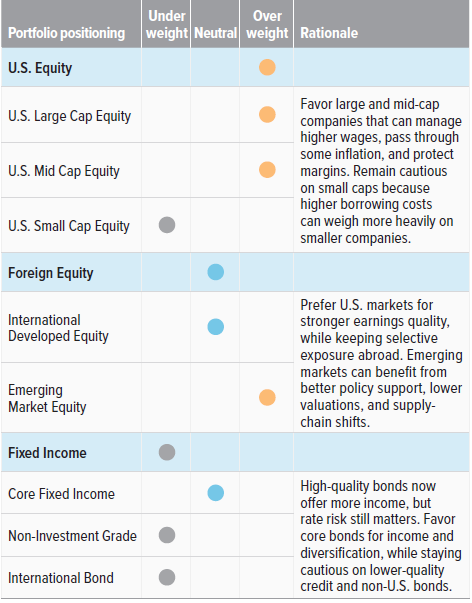
In equities, we remain modestly overweight and continue to favor the U.S. Earnings growth supports our view, but the market has been led by a narrow group of stocks. A broader earnings recovery would make the rally healthier. We favor high-quality large companies with steady cash flow and less dependence on debt. AI remains an important opportunity, but expectations are high. Investors should stay diversified in case AI spending slows, profit margins come under pressure, or earnings disappoint.
Outside the U.S., lower valuations alone are not enough. We remain neutral on developed international stocks and prefer Japan, where companies are improving how they use capital and return cash to shareholders. Europe has opportunities in defense, infrastructure, and financials, but energy costs and fiscal risks remain concerns. We are modestly overweight emerging markets, with a focus on Asia’s semiconductor and hardware leadership, India’s domestic growth, and supply-chain relocation. China’s manufacturing and exports are strengths, but weak consumer demand limits the case for a broad recovery.
In fixed income, higher yields again provide meaningful income and can help diversify a portfolio. Still, bonds may not protect investors in every market, especially when inflation concerns push rates higher. We favor intermediateterm U.S. core bonds, including Treasuries, agencies, highquality securitized bonds, and investment-grade corporate bonds. These areas provide income and flexibility if growth weakens, without taking too much risk in long-term bonds or lower-quality credit. A strong dollar and fiscal uncertainty also keep us cautious on non-U.S. bonds.
Key Takeaways
The Voya Growth Builder Portfolios delivered mixed absolute and relative returns during the third quarter, with more aggressive portfolios outperforming fixed income-heavy conservative portfolios as equities posted modest gains and bonds declined.
Strategic asset allocation contributed to performance, led by an overweight to equities relative to fixed income and an underweight to U.S. small-cap equities, while manager selection detracted overall.
The portfolios maintained a preference for U.S. equities, particularly high-quality large-cap companies, while remaining neutral on developed international equities and modestly overweight emerging markets.
Within fixed income, the portfolios continued to favor intermediate-duration U.S. core bonds for income and diversification, while maintaining a more cautious stance toward lower-rated credit and non-U.S. bonds.